
Key facts
- Brand
- Philips
- Model
- BFG505W
- Industry
- Industrial
- Documents
- 2
- Languages
- EN
- Last added
- 2012-07-06
Start here
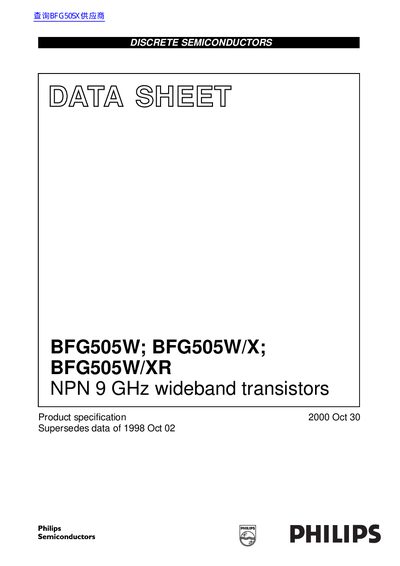
Philips BFG505W NPN 9 GHz Wideband Transistors Datasheet
This datasheet describes the BFG505W, BFG505W/X, and BFG505W/XR, which are NPN silicon planar epitaxial transistors designed for RF front-end applications in the GHz range. These devices feature high power gain and low noise figures, making them suitable for use in cellular telephones, radar detectors, and satellite television tuners.
Read onlinePhilips BFG505W specifications
| Collector-Base Voltage | 20 V |
|---|---|
| Collector-Emitter Voltage | 15 V |
| Collector Current (DC) | 18 mA |
| Total Power Dissipation | 500 mW |
| Transition Frequency | 9 GHz |
| Maximum Unilateral Power Gain | 19 dB |
| Insertion Power Gain | 16 dB |
| Noise Figure | 1.9 dB |
Source: Philips BFG505W NPN 9 GHz Wideband Transistors Datasheet
All Philips BFG505W documents by type
Ratings, dimensions and ordering codes, for selection and design work.
Questions answered in these manuals
What is the maximum power dissipation?
The total power dissipation is 500 mW when the temperature is below 85 °C.
From: Philips BFG505W NPN 9 GHz Wideband Transistors Datasheet
What is the transition frequency?
The transition frequency is 9 GHz under specified test conditions.
From: Philips BFG505W NPN 9 GHz Wideband Transistors Datasheet
What applications are these transistors designed for?
These transistors are intended for front end applications in the GHz range, such as analog and digital cellular telephones, cordless telephones, radar detectors, pagers, and satellite television tuners.
What is the maximum total power dissipation for this transistor?
The maximum total power dissipation is 500 mW when the temperature at the soldering point of the collector pin is less than 85 °C.