
Key facts
- Brand
- Philips
- Model
- 74F224
- Documents
- 4
- Languages
- EN
- Last added
- 2012-07-06
Start here
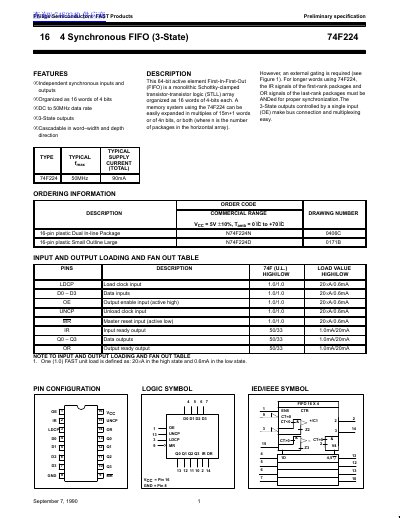
Philips Semiconductors 16 × 4 Synchronous FIFO (3-State) 74F224 Manual
This document is a preliminary specification sheet for the 74F224, a monolithic Schottky-clamped transistor-transistor logic (STLL) array. The device functions as a First-In-First-Out (FIFO) memory element organized into 16 words of 4 bits each.
Read onlinePhilips 74F224 specifications
| Propagation Delay (Typical) | 4.0ns |
|---|---|
| Operating Temperature Range | 0°C to +70 °C |
| Output Termination Resistance | 30 Ohm |
Source: Philips Semiconductors 74F2245 Octal Transceiver Datasheet
All Philips 74F224 documents by type
Ratings, dimensions and ordering codes, for selection and design work.
Questions answered in these manuals
How is the 74F224 FIFO organized?
The device is organized as 16 words of 4 bits each.
From: Philips Semiconductors 16 × 4 Synchronous FIFO (3-State) 74F224 Manual
What is the maximum data rate for this chip?
The typical maximum frequency is 50MHz.
From: Philips Semiconductors 16 × 4 Synchronous FIFO (3-State) 74F224 Manual
What is the primary application of the 74F2245?
It is designed to drive DRAM due to its 30 Ohm series termination on the outputs.
From: Philips Semiconductors 74F2245 Octal Transceiver Datasheet
What happens to the outputs when power is removed?
The outputs are placed in a high impedance state during power-off conditions.
From: Philips Semiconductors 74F2245 Octal Transceiver Datasheet
What is the primary application of the 74F2244?
It is ideal for driving dynamic DRAM with matching impedance.
From: PHILIPS 74F2244 Octal buffer with 30Ω equivalent output termination (3-State) handbook
What is the output termination resistance?
The device features a 30 Ω equivalent output termination.
From: PHILIPS 74F2244 Octal buffer with 30Ω equivalent output termination (3-State) handbook