
Key facts
- Brand
- Philips
- Model
- 52C
- Category
- microcontrollers
- Industry
- Electronics
- Documents
- 4
- Languages
- EN
- Last added
- 2012-07-05
Start here
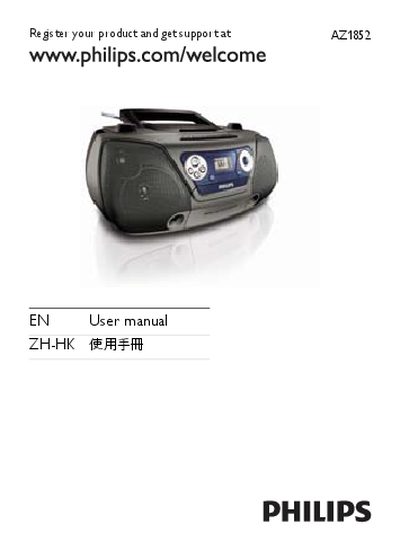
Philips AZ1852 CD Soundmachine User Manual
This manual covers important safety information, proper battery handling, and hearing‑safety guidelines for the Philips AZ1852 CD Soundmachine. It also explains the functions of the remote control, front panel controls, and supported media formats.
Additional sections describe cleaning and maintenance procedures, detailed technical specifications, and troubleshooting steps for common issues such as no power, no sound, or USB compatibility problems. Disposal and recycling information for the unit and its batteries are also included.
Philips 52C specifications
| CPU Architecture | 8-bit CPU, ROM, RAM, EEPROM and I/O |
|---|---|
| ROM Size (PCA3351C/PCD3351A) | 2 kbytes |
| RAM Size (PCA3352C/PCD3352A) | 128 bytes |
| EEPROM Size | 128 bytes |
| I/O Port Lines | 20 quasi-bidirectional I/O port lines |
| Supply Voltage Range | 1.8 to 6 V |
| Clock Frequency Range | 1 to 16 MHz |
All Philips 52C documents by type
Ratings, dimensions and ordering codes, for selection and design work.
Day-to-day operation, settings and troubleshooting. Start here if the product is already set up.
Questions answered in these manuals
What is the operating ambient temperature range for PCA335xC?
The operating ambient temperature range for PCA335xC devices is fixed at 0 to +50 °C.
What is the operating ambient temperature range for PCD335xA?
The operating ambient temperature range for PCD335xA devices is -25 to +70 °C.
Does the PML2852 support power down mode?
Yes, the device includes a power down mode where power dissipation is reduced to a mere 52mW, making it ideal for laptop or pocket computers.
From: Philips PML2852 CMOS Programmable Macro Logic Datasheet
What development systems support the PML2852?
The device is supported by advanced SNAP and SLICE development systems, which support schematic entry, logic equations, and state equations.
From: Philips PML2852 CMOS Programmable Macro Logic Datasheet
What is the propagation delay for the PML2552?
The delay per internal NAND gate is 15ns typical, and the flip-flop toggle rate is 50MHz.
From: Philips PML2552 CMOS Programmable Macro Logic Datasheet
How does the scan test feature operate?
The scan test feature allows access to internal flip-flop nodes using dedicated pins SCI (Scan In) and SCM (Scan Mode) to shift test patterns.
From: Philips PML2552 CMOS Programmable Macro Logic Datasheet