
Key facts
- Brand
- Philips
- Model
- BUK203-50Y
- Category
- Other Electronics
- Documents
- 2
- Languages
- EN
- Last added
- 2012-07-06
Start here
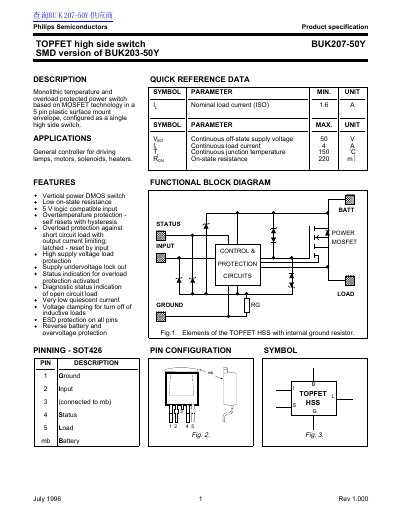
PHILIPS TOPFET high side switch BUK207-50Y SMD version of BUK203-50Y handbook
This document is a product specification for the TOPFET high side switch BUK207-50Y, which is an SMD version of BUK203-50Y. It provides detailed information about the electrical characteristics, limiting values, static and dynamic characteristics, protection functions, and other technical specifications of the device.
The device is a monolithic temperature and overload protected power switch based on MOSFET technology in a 5 pin plastic surface mount envelope, configured as a single high side switch. It features low on-state resistance, 5 V logic compatible input, overtemperature protection with self-reset hysteresis, and overload protection against short circuit load without output current limiting.
Philips BUK203-50Y specifications
| Nominal load current (ISO) | 1.6 A |
|---|---|
| Continuous off-state supply voltage | 50 V |
| Continuous load current | 4 A |
| Continuous junction temperature | 150 °C |
| On-state resistance (VBG = 13 V) | 220 mΩ |
| Storage temperature | -55 to 175 °C |
Source: PHILIPS TOPFET high side switch BUK207-50Y SMD version of BUK203-50Y handbook
All Philips BUK203-50Y documents by type
Ratings, dimensions and ordering codes, for selection and design work.
Questions answered in these manuals
Does the switch have overtemperature protection?
Yes, it has overtemperature protection that self-resets with hysteresis.
From: PHILIPS TOPFET high side switch BUK207-50Y SMD version of BUK203-50Y handbook
What is the maximum continuous junction temperature for normal operation?
The device allows a continuous junction temperature of up to 150 °C.
From: PHILIPS TOPFET high side switch BUK207-50Y SMD version of BUK203-50Y handbook
Does this component have overtemperature protection?
Yes, it includes overtemperature protection that self resets with hysteresis.
How much energy can the device clamp during inductive load turn-off?
It can handle up to 1.4 J of non-repetitive clamping energy at a junction temperature of 150 °C.