
Key facts
- Brand
- Analog Devices
- Model
- ADCLK946
- Industry
- Industrial
- Documents
- 3
- Languages
- EN
- Last added
- 2026-10-08
Start here
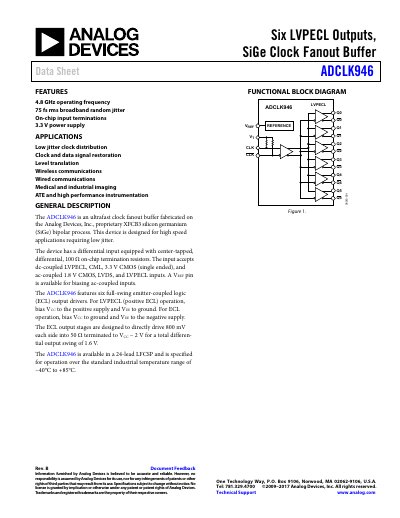
Analog Devices ADCLK946 Clock Fanout Buffer Data Sheet
The ADCLK946 clock fanout buffer, fabricated on Analog Devices' XFCB3 SiGe bipolar process, provides six full‑swing LVPECL outputs for high‑speed clock distribution. It supports a wide range of input standards (LVPECL, CML, CMOS, LVDS) and includes on‑chip terminations and a VREF pin for biasing ac‑coupled inputs.
The device is supplied in a 24‑lead LFCSP package (4 mm × 4 mm) and operates over an industrial temperature range of –40 °C to +85 °C. Detailed specifications, pin descriptions, PCB layout guidelines, and termination options are provided for designers.
Analog Devices ADCLK946 specifications
| Maximum Operating Frequency | 4.8 GHz |
|---|---|
| Broadband Random Jitter | 75 fs rms |
| Input Voltage High Level (VIH) | VEE + 1.6 VCC |
| Output Voltage High Level (VOH) Typical | VCC − 1.26 V |
| Supply Voltage Requirement (VCC‑VEE) Typical | 3.63 V |
| Positive Supply Current (IVCC) Typical | 275 mA |
Source: Analog Devices ADCLK946 Clock Fanout Buffer Data Sheet
All Analog Devices ADCLK946 documents by type
Ratings, dimensions and ordering codes, for selection and design work.
Questions answered in these manuals
What is the maximum operating frequency of the ADCLK946?
The device can operate up to 4.8 GHz.
From: Analog Devices ADCLK946 Clock Fanout Buffer Data Sheet
What is the typical broadband random jitter of the ADCLK946?
Typical broadband random jitter is 75 fs rms.
From: Analog Devices ADCLK946 Clock Fanout Buffer Data Sheet
What is the maximum operating frequency of the ADCLK946?
The device can operate up to 4.8 GHz.
What supply voltage does the ADCLK946 require?
It requires a 3.3 V supply, with a typical range of 2.97 V to 3.63 V.
What is the maximum operating frequency of the ADCLK946?
The ADCLK946 can operate up to 4.8 GHz.
How many LVPECL outputs does the ADCLK946 provide?
It provides six full‑swing LVPECL (ECL) output drivers.