
Key facts
- Brand
- Analog Devices
- Model
- AD7572A
- Category
- Other Electronics
- Documents
- 2
- Languages
- EN
- Last added
- 2012-08-02
Start here
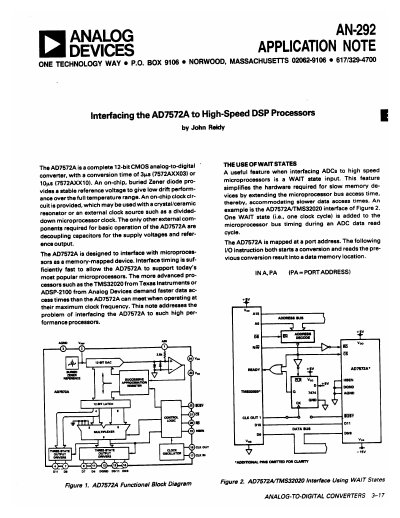
Analog Devices AN-292 Application Note Interfacing the AD7572A to High-Speed DSP Processors
The document describes the AD7572A, a 12-bit CMOS analog-to-digital converter, and addresses the challenge of interfacing it with high-performance microprocessors that have faster data access times than the ADC can support. It details the use of wait states to extend bus access time and reduce noise issues caused by high-speed microprocessor activity.
Furthermore, the note provides specific interface circuits for the TMS32020 and ADSP-2100 processors. It discusses using external timers, such as the 8254 or a 74393 counter, to ensure equal sampling intervals and allow the processor to operate at maximum speed while the ADC performs conversions.
Analog Devices AD7572A specifications
| Resolution | 12-bit |
|---|---|
| Conversion Time (Standard) | 3us |
| Conversion Time (Slow) | 10us |
Source: Analog Devices AN-292 Application Note Interfacing the AD7572A to High-Speed DSP Processors
All Analog Devices AD7572A documents by type
How to use the product for one specific task, with worked examples.
Ratings, dimensions and ordering codes, for selection and design work.
Questions answered in these manuals
How can microprocessor noise be eliminated during ADC conversion?
Noise can be eliminated by using wait states for the duration of the ADC conversion time or by using three-state buffers to isolate the ADC data bus.
From: Analog Devices AN-292 Application Note Interfacing the AD7572A to High-Speed DSP Processors
What is the advantage of using an external timer for conversion control?
Using an external timer allows the processor to operate at maximum speed while the AD7572A performs conversions at constant sampling intervals.
From: Analog Devices AN-292 Application Note Interfacing the AD7572A to High-Speed DSP Processors
What is the conversion time for the AD7572AXX03 version?
The synchronous clock conversion time is 3.125 ps maximum.
What is the operating temperature range for the Industrial version?
The Industrial (A Version) operates from -40°C to +85°C.