
Key facts
- Brand
- Analog Devices
- Model
- ADG706/ADG707
- Category
- Other Electronics
- Industry
- Electronics
- Documents
- 3
- Languages
- EN
- Last added
- 2026-10-18
Start here
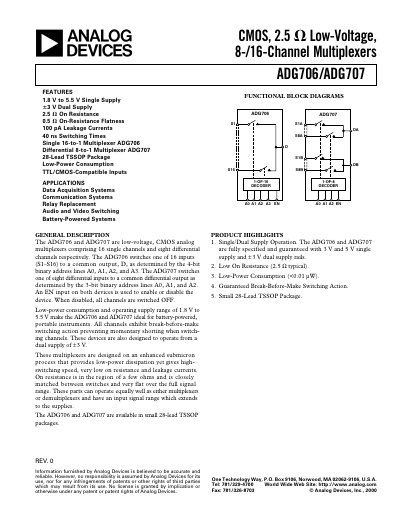
Analog Devices ADG706/ADG707 CMOS Analog Multiplexer Datasheet
The ADG706 and ADG707 are low-voltage, CMOS analog multiplexers available in a 28-lead TSSOP package. The ADG706 functions as a single 16-to-1 multiplexer, while the ADG707 acts as a differential 8-to-1 multiplexer. Both devices feature low on-resistance, low power consumption, and guaranteed break-before-make switching action to prevent momentary shorting.
Read onlineAnalog Devices ADG706/ADG707 specifications
| Supply Voltage | 1.8 V to 5.5 V Single / ±3 V Dual |
|---|---|
| On Resistance | 2.5 Ω typical |
| Leakage Current | 100 pA |
| Switching Times | 40 ns |
| Package Type | 28-Lead TSSOP |
| Operating Temperature (Industrial) | -40 °C to +85 °C |
| Bandwidth (ADG706) | 25 MHz |
| Bandwidth (ADG707) | 36 MHz |
Source: Analog Devices ADG706/ADG707 CMOS Analog Multiplexer Datasheet
All Analog Devices ADG706/ADG707 documents by type
Ratings, dimensions and ordering codes, for selection and design work.
Questions answered in these manuals
What is the difference between the ADG706 and ADG707?
The ADG706 is a single 16-to-1 multiplexer, while the ADG707 is a differential 8-to-1 multiplexer.
From: Analog Devices ADG706/ADG707 CMOS Analog Multiplexer Datasheet
Do these multiplexers support dual supply operation?
Yes, they are designed to operate from a dual supply of ±3 V in addition to single supplies.
From: Analog Devices ADG706/ADG707 CMOS Analog Multiplexer Datasheet
How low is the leakage current when the switch is off?
The source OFF leakage current is typically ±0.01 nA.
What is the switching speed of the device?
The typical transition time is 40 ns.
What supply voltage range do the ADG706 and ADG707 support?
They operate from a single supply of +1.8 V to +5.5 V or from a dual supply of +2.5 V.
How many channels does each device provide?
The ADG706 provides a 16‑to‑1 single‑ended multiplexer, while the ADG707 provides an 8‑to‑1 differential multiplexer.