
Key facts
- Brand
- STMicroelectronics
- Model
- RHFL4913A
- Documents
- 2
- Languages
- EN
- Last added
- 2012-08-08
Start here
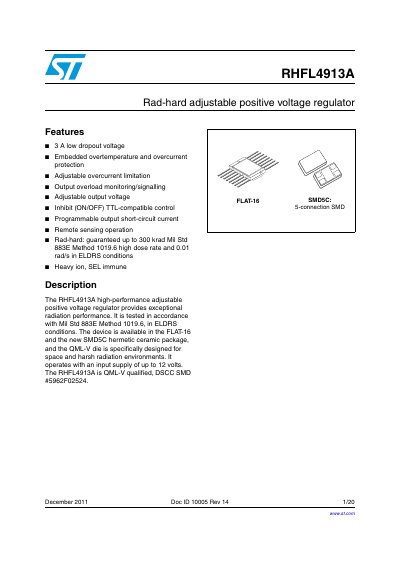
STMicroelectronics RHFL4913A Rad-hard Adjustable Positive Voltage Regulator Datasheet
The RHFL4913A is a high-performance adjustable positive voltage regulator designed for space and harsh radiation environments. It features a QML-V qualified die and is available in FLAT-16 and SMD5C hermetic ceramic packages. The device operates with an input supply up to 12V and offers features such as embedded overtemperature and overcurrent protection, adjustable output voltage, and remote sensing operation.
Read onlineSTMicroelectronics RHFL4913A specifications
| Output current | 3A |
|---|---|
| Radiation tolerance | 300 krad |
| DC input voltage | 12 V |
| Output voltage range | 1.23 to 9 V |
| Operating junction temperature | -55 to +150 °C |
| Dropout voltage (Typ) | 550 mV |
Source: STMicroelectronics RHFL4913A Rad-hard Adjustable Positive Voltage Regulator Datasheet
All STMicroelectronics RHFL4913A documents by type
Ratings, dimensions and ordering codes, for selection and design work.
How to use the product for one specific task, with worked examples.
Questions answered in these manuals
What is the maximum input voltage?
The maximum DC input voltage is 12 V.
From: STMicroelectronics RHFL4913A Rad-hard Adjustable Positive Voltage Regulator Datasheet
Is the device radiation hard?
Yes, it is rad-hard guaranteed up to 300 krad.
From: STMicroelectronics RHFL4913A Rad-hard Adjustable Positive Voltage Regulator Datasheet
What capacitor values are recommended for SET mitigation?
It is advisable to use tantalum input and output capacitors with a minimum of 1 uF, along with decoupling polyester capacitors.
How can short-duration SET pulses be minimized?
Short-duration pulses depend on ESL and stray inductances; they cannot be suppressed by increasing capacitance but require board-level actions like low ESR capacitors.