
This document deals with the effects of SET (single event transient) on the output of the RHFL4913A low-drop linear regulator and introduces some solutions for coping with these effects.
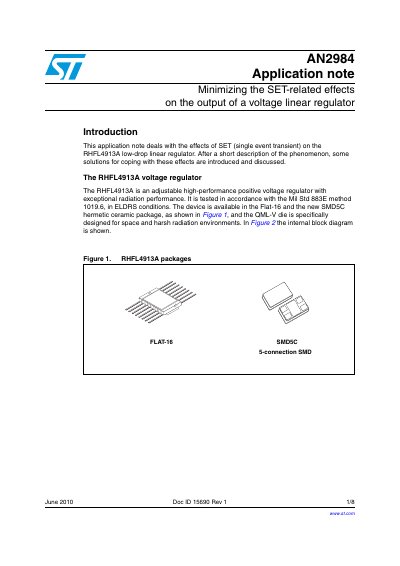
The document addresses the impact of SET phenomena, specifically heavy-ion disturbances, on the output voltage of the RHFL4913A adjustable high-performance positive voltage regulator. It details how these transients can cause excessive current or supply stoppage for approximately one microsecond, potentially affecting sensitive devices like FPGAs.
| Input Supply Voltage | up to 12 V |
|---|---|
| Minimum Output Voltage | 1.22 V |
| Minimum Input Voltage | 3 V |
| Bandgap Reference Voltage | 1.23 V |
It is advisable to use tantalum input and output capacitors with a minimum of 1 uF, along with decoupling polyester capacitors.
Short-duration pulses depend on ESL and stray inductances; they cannot be suppressed by increasing capacitance but require board-level actions like low ESR capacitors.