
Key facts
- Brand
- Analog Devices
- Model
- ADV7189
- Industry
- Industrial
- Documents
- 3
- Languages
- EN
- Last added
- 2012-08-02
Start here
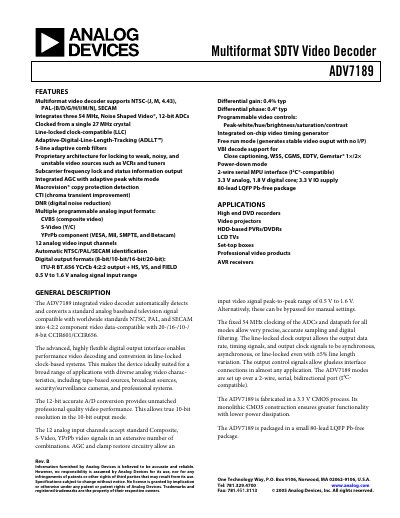
Analog Devices ADV7189 Multiformat SDTV Video Decoder Datasheet
The ADV7189 is a high-quality, single-chip multiformat video decoder that automatically detects and converts standard analog baseband television signals (NTSC, PAL, and SECAM) into digital ITU-R BT.656 format. It integrates three 54 MHz, 12-bit Noise Shaped Video ADCs clocked from a single 27 MHz crystal, enabling precise sampling and digital filtering.
Read onlineAnalog Devices ADV7189 specifications
| ADC Resolution | 12-bit |
|---|---|
| Clock Frequency | 27 MHz |
| Analog Input Channels | 12 |
| Input Signal Range | 0.5 V to 1.6 V |
| Digital Output Formats | 8-bit/10-bit/16-bit/20-bit |
| Package Type | 80-lead LQFP Pb-free |
| Analog Supply Voltage | 3.3 V |
| Digital Core Voltage | 1.8 V |
Source: Analog Devices ADV7189 Multiformat SDTV Video Decoder Datasheet
All Analog Devices ADV7189 documents by type
Ratings, dimensions and ordering codes, for selection and design work.
Questions answered in these manuals
What video standards does the ADV7189 support?
The device supports NTSC-(J, M, 4.43), PAL-(B/D/G/H/I/M/N), and SECAM standards.
From: Analog Devices ADV7189 Multiformat SDTV Video Decoder Datasheet
What are the supported analog input formats?
It accepts CVBS (composite video), S-Video (Y/C), and YPrPb component signals.
From: Analog Devices ADV7189 Multiformat SDTV Video Decoder Datasheet
What video standards does the ADV7189 support?
It supports PAL, NTSC, and SECAM standards in composite, S‑Video, and component formats.
What is the analog power supply voltage range for the ADV7189?
The analog supply voltage (AVDD) operates from 3.15 V to 3.45 V.
What video standards does the ADV7189 support?
It supports NTSC, PAL and SECAM standards in composite, S‑Video and component formats.
What is the digital output format of the ADV7189?
The decoder outputs ITU‑R BT.656 4:2:2 component video in 8‑bit, 10‑bit, 16‑bit or 20‑bit modes.