
Key facts
- Brand
- Analog Devices
- Model
- AD5663
- Category
- Other Electronics
- Documents
- 2
- Languages
- EN
- Last added
- 2012-05-09
Start here
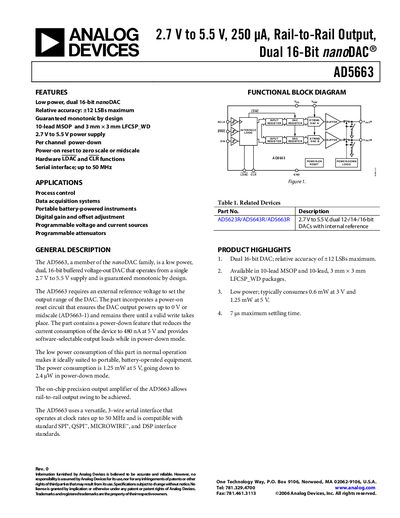
Analog Devices AD5663 Datasheet
The AD5663 is a dual 16‑bit buffered voltage‑output DAC that operates from a single 2.7 V to 5.5 V supply and is guaranteed monotonic by design. It offers low power consumption (1.25 mW at 5 V) and a rail‑to‑rail output swing, making it suitable for portable, battery‑operated instruments.
The device provides a versatile 3‑wire serial interface compatible with SPI, QSPI, Microwire and DSP standards, and includes per‑channel power‑down, hardware LDAC and CLR functions. Detailed specifications cover resolution, accuracy, timing, AC characteristics, absolute maximum ratings and pin functions.
Analog Devices AD5663 specifications
| Resolution | 16 bits |
|---|---|
| Relative Accuracy | +12 LSB (maximum) |
| Supply Voltage | 2.7 V to 5.5 V |
| Power Consumption (normal operation at 5 V) | 1.25 mW |
| Maximum Settling Time | 7 µs |
| Serial Interface Speed | up to 50 MHz |
Source: Analog Devices AD5663 Datasheet
All Analog Devices AD5663 documents by type
Ratings, dimensions and ordering codes, for selection and design work.
Questions answered in these manuals
What is the supply voltage range for the AD5663?
The AD5663 operates from a single supply of 2.7 V to 5.5 V.
What is the maximum settling time of the AD5663?
The device settles to within ±2 LSB in 7 µs.
What is the typical power consumption of the AD5623R?
It typically consumes 0.6 mW at 3 V and 1.25 mW at 5 V.
From: Analog Devices AD5623R/AD5643R/AD5663R Dual NanoDAC Handbook
How fast can the serial interface operate?
The serial interface supports clock rates up to 50 MHz.
From: Analog Devices AD5623R/AD5643R/AD5663R Dual NanoDAC Handbook