
Key facts
- Brand
- Analog Devices
- Model
- AD9523
- Category
- Other Electronics
- Documents
- 3
- Languages
- EN
- Last added
- 2012-08-02
Start here
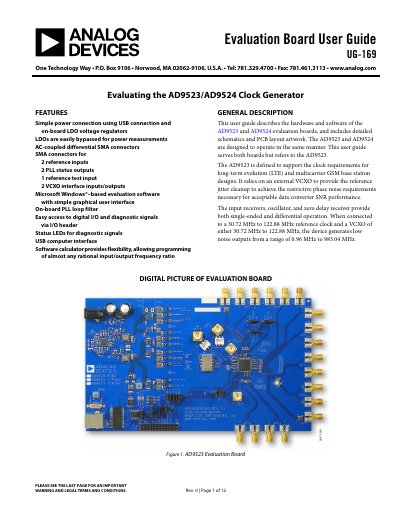
ANALOG DEVICES UG-169 handbook
This document serves as the user guide for the AD9523 and AD9524 evaluation boards. It describes the hardware and software components, including detailed schematics and PCB layout artwork. The guide is applicable to both boards but primarily refers to the AD9523.
Read onlineAnalog Devices AD9523 specifications
| Output frequency range | <1 MHz to 1 GHz |
|---|---|
| Start‑up frequency accuracy | <±100 ppm |
| Zero‑delay operation | Supported |
| Output‑to‑output skew | <50 ps |
| Absolute output jitter (122.88 MHz) | <150 fs |
| On‑chip VCO frequency range | 2940 MHz to 3100 MHz |
Source: Analog Devices AD9523-1 Low Jitter Clock Generator Datasheet
All Analog Devices AD9523 documents by type
Day-to-day operation, settings and troubleshooting. Start here if the product is already set up.
Ratings, dimensions and ordering codes, for selection and design work.
Questions answered in these manuals
What frequency range does the AD9523 generate when connected to a specific reference clock?
When connected to a 30.72 MHz to 122.88 MHz reference clock and a VCXO of either 30.72 MHz to 122.88 MHz, the device generates low noise outputs from a range of 0.96 MHz to 983.04 MHz.
What is the required amplitude setting for the signal generator connected to REF A SMA Connector J9?
An amplitude setting of 6 dBm is sufficient when connecting a signal generator to REF A SMA Connector J9.
What is the output frequency range of the AD9523-1?
The device can generate outputs from less than 1 MHz up to 1 GHz.
From: Analog Devices AD9523-1 Low Jitter Clock Generator Datasheet
What is the absolute output jitter at 122.88 MHz?
The absolute output jitter is less than 150 fs at 122.88 MHz.
From: Analog Devices AD9523-1 Low Jitter Clock Generator Datasheet
What is the output frequency range of the AD9523?
The AD9523 supports output frequencies from less than 1 MHz up to 1 GHz.
How many configurable outputs does the AD9523 provide and what standards can they use?
It provides 14 outputs that can be configured as LVPECL, LVDS, HSTL, or LVCMOS.