
Key facts
- Brand
- Analog Devices
- Model
- AD8015
- Industry
- Industrial
- Documents
- 3
- Languages
- EN
- Last added
- 2012-08-02
Start here
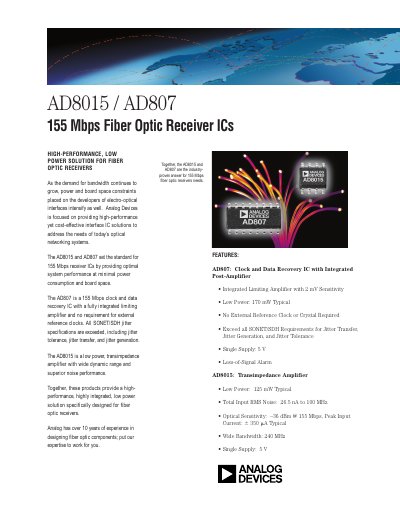
Analog Devices AD8015/AD807 Fiber Optic Receiver ICs Datasheet
The document introduces the AD8015 and AD807 as a complete solution for 155 Mbps fiber optic receivers. The AD807 is a clock and data recovery IC featuring an integrated limiting amplifier, while the AD8015 serves as a low-power transimpedance amplifier with wide dynamic range.
Read onlineAnalog Devices AD8015 specifications
| Typical Power Consumption (AD807) | 170 mW |
|---|---|
| Typical Power Consumption (AD8015) | 125 mW |
| Total Input RMS Noise (AD8015) | 26.5 nA to 100 MHz |
| Optical Sensitivity (AD8015) | -36 dBm @ 155 Mbps |
| Peak Input Current (AD8015) | +350 pA Typical |
| Wide Bandwidth (AD8015) | 240 MHz |
Source: Analog Devices AD8015/AD807 Fiber Optic Receiver ICs Datasheet
All Analog Devices AD8015 documents by type
Ratings, dimensions and ordering codes, for selection and design work.
Questions answered in these manuals
What is the primary application for the AD8015 and AD807?
They are designed specifically for fiber optic receivers operating at 155 Mbps.
From: Analog Devices AD8015/AD807 Fiber Optic Receiver ICs Datasheet
Does the AD807 require an external reference clock?
No, it has no requirement for external reference clocks or crystals.
From: Analog Devices AD8015/AD807 Fiber Optic Receiver ICs Datasheet
What is the typical bandwidth of the AD8015?
The AD8015 has a typical 3 dB bandwidth of 240 MHz.
From: Analog Devices AD8015 Wideband/Differential Output Transimpedance Amplifier Datasheet
How much input current noise does the AD8015 exhibit at 100 MHz?
It exhibits 3.0 pA/√Hz input current noise at 100 MHz.
From: Analog Devices AD8015 Wideband/Differential Output Transimpedance Amplifier Datasheet