
Key facts
- Brand
- Agilent
- Model
- 320-MS
- Industry
- Industrial
- Documents
- 20
- Languages
- EN
- Last added
- 2012-07-05
Start here
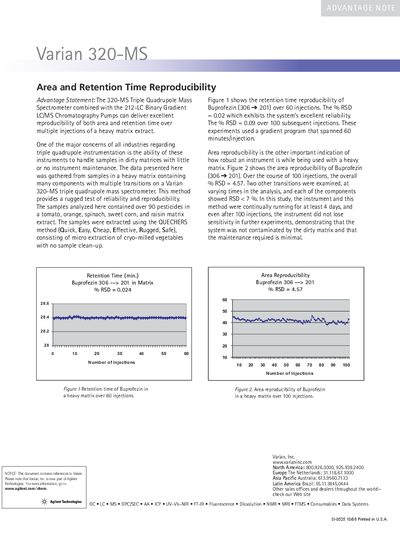
Varian 320-MS Triple Quadrupole Mass Spectrometer Area and Retention Time Reproducibility Advantage Statement
The document serves as an advantage statement for the Varian 320-MS Triple Quadrupole Mass Spectrometer combined with 212-LC Binary Gradient LC/MS Chromatography Pumps. It highlights the system's ability to deliver excellent reproducibility of both area and retention time over multiple injections, even when handling samples in dirty matrices containing many components.
Read onlineAgilent 320-MS specifications
| Mass Range | 2000 m/z |
|---|---|
| Sensitivity | Femtogram |
| Linear Footprint | < 72 cm (28 inches) |
Source: Varian 320-MS Triple Quadrupole Mass Spectrometer Product Brochure
All Agilent 320-MS documents by type
Day-to-day operation, settings and troubleshooting. Start here if the product is already set up.
How to use the product for one specific task, with worked examples.
- Agilent 320-MS Triple Quadrupole Mass Spectrometer Application Note 01992 3 p
- Agilent Fast Sensitive EtG Analysis in Urine With Pursuit C18 HPLC Column the 320-MS LC/MS/MS Application Note 2 p
- Varian 320-MS Triple Quadrupole LC/MS/MS Application Note for Azo Dye Analysis 3 p
- Agilent 320-MS Triple Quadrupole LC/MS/MS Application Note for Phenoxy Herbicides 3 p
- Agilent 320-MS Multi Component Mycotoxin Analysis Application Note 5 p
- Agilent 320-MS Triple Quadrupole LC/MS/MS Application Note for Phenoxy Herbicides Analysis 3 p
- Varian 320-MS Triple Quadrupole LC/MS/MS Phospholipid Characterization Application Note 3 p
- Agilent 320-MS Triple Quadrupole Mass Spectrometer Application Note 00542 3 p
- Agilent 320-MS LC/MS/MS Application Note 00317 3 p
- Agilent 320-MS Triple Quadrupole Mass Spectrometer Application Note 00526 2 p
- Agilent 320-MS Triple Quadrupole Mass Spectrometer Application Note 3 p
- Agilent 320-MS LC/MS/MS Application Note for Aflatoxin Analysis 4 p
- Agilent 320-MS Triple Quadrupole LC/MS/MS Application Note for Imazaquin Analysis 2 p
- Varian 320-MS Vitamin D2 and D3 Analysis Application Note 2 p
Mounting, wiring and first power-up. Read it before the hardware goes in.
- Varian 320-MS Triple Quadrupole Mass Spectrometer Area and Retention Time Reproducibility Advantage Statement 1 p
- Agilent 320-MS LC/MS/MS Advantage Statement 2 p
- Varian 320-MS Qualifier Assessment and Ion Ratio Stability Advantage Statement 3 p
- Varian 320-MS Triple Quadrupole Mass Spectrometer Product Brochure 6 p
Questions answered in these manuals
What sample matrix and extraction method were used to test the instrument?
The samples contained over 90 pesticides extracted from tomato, orange, spinach, sweet corn, and raisin using the QUECHERS method with no sample clean-up.
How many injections were performed for the retention time reproducibility test?
The retention time reproducibility of Buprofezin was tested over 60 injections.
What is the specific off-axis angle of the Varian 320-MS collision cell?
The instrument features a unique 180° off-axis collision configuration.
What matrix was used for the chromatograms shown in Figures 2 and 3?
The analysis of four acidic herbicides was performed using an onion matrix.
What is the default tolerance level for the qualifier ion ratio in the European Union guidelines?
The default tolerance level is 20%.
From: Varian 320-MS Qualifier Assessment and Ion Ratio Stability Advantage Statement
What was the average observed ion ratio tolerance for Aflatoxin B1 over four orders of magnitude?
The average observed tolerance was 7.15%.
From: Varian 320-MS Qualifier Assessment and Ion Ratio Stability Advantage Statement