
The document provides basic knowledge about glucuronidation, including the enzyme family, gene differentiation, and substrates. Understanding UGTs and their substrates is becoming increasingly important from an epidemiological and pharmacological perspective.
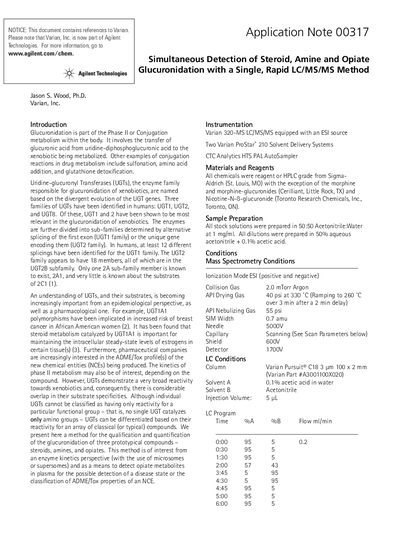
This document presents a method for the qualification and quantification of glucuronidation for three prototypical compounds: steroids, amines, and opiates. The method utilizes the Agilent 320-MS LC/MS/MS system equipped with an ESI source to detect metabolites in less than five minutes.
The application demonstrates the system's sensitivity and ability to handle complex matrices, including enzyme kinetics mixtures and plasma-like matrices containing bovine serum albumin (BSA). It details specific mass spectrometry and liquid chromatography conditions, including column type, solvent composition, and scan parameters for compounds such as morphine-glucuronide and estradiol-glucuronide.
| Instrumentation | Varian 320-MS LC/MS/MS equipped with an ESI source |
|---|---|
| Solvent Delivery Systems | Two Varian ProStar 210 Solvent Delivery Systems |
| AutoSampler | CTC Analytics HTS PAL AutoSampler |
| Column | Varian Pursuit C18 3 um 100 x 2mm |
| Injection Volume | 5 ul |
| Run Time | Less than five minutes |
| LOQ for Morphine-Glucuronide | 244 fg |
The method detects the glucuronidation of three prototypical compounds: steroids, amines, and opiates.
Good separation of all glucuronides is obtained in less than five minutes.
The sensitivity shows a limit of quantitation of 244 fg for morphine-glucuronide in a clean matrix.