
Key facts
Start here
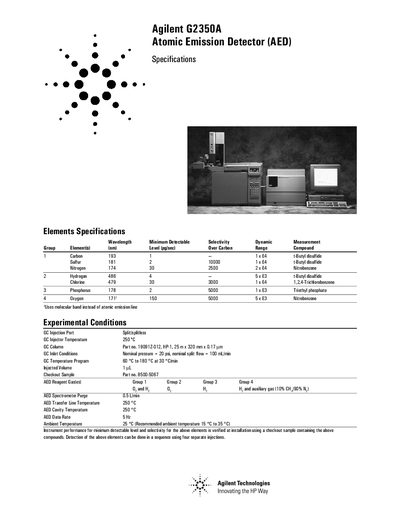
Agilent G2350A Atomic Emission Detector Datasheet
This document provides technical specifications for the Agilent G2350A Atomic Emission Detector (AED), detailing its capabilities for detecting elements such as Carbon, Sulfur, Nitrogen, Hydrogen, Chlorine, Phosphorus, and Oxygen. It includes performance data for minimum detectable levels and selectivity for various compounds.
Read onlineAgilent G2350A specifications
| Wavelength Range | 171 to 837 nm |
|---|---|
| Microwave Frequency | 2,450 MHz |
| Microwave Power | 70 watts |
| Minimum Detectable Level (Carbon) | 1 pg/sec |
| Minimum Detectable Level (Sulfur) | 2 pg/sec |
| Minimum Detectable Level (Nitrogen) | 30 pg/sec |
| Minimum Detectable Level (Hydrogen) | 4 pg/sec |
| Minimum Detectable Level (Chlorine) | 30 pg/sec |
| Minimum Detectable Level (Phosphorus) | 2 pg/sec |
| Minimum Detectable Level (Oxygen) | 150 pg/sec |
| Operating Temperature | 10 °C to 40 °C |
| Data Rate | 5 Hz |
All Agilent G2350A documents by type
Ratings, dimensions and ordering codes, for selection and design work.
How to use the product for one specific task, with worked examples.
Mounting, wiring and first power-up. Read it before the hardware goes in.
Questions answered in these manuals
What is the minimum detectable level for Carbon?
The minimum detectable level for Carbon is 1 pg/sec.
What purity is required for Helium gas?
Helium gas must be 99.9999% pure for GC carrier and AED plasma.
Which injection volume showed better response factor reproducibility?
The data indicates that response factor reproducibility is better for 1.0 µL injections compared to 0.1 µL injections.
From: Agilent G2350A GC-AED Compound-Independent Calibration Application Note
What was the largest error observed during EMR calculations?
The largest error was seen when calibrating on endosulfan sulfate due to a low area on the oxygen chromatogram.
From: Agilent G2350A GC-AED Compound-Independent Calibration Application Note
What instruments are used for the stack gas analysis?
The analysis is performed with an Agilent 6890 gas chromatograph and an Agilent G2350A atomic emission detector.
From: Agilent 6890/G2350A Stack Flare Gas Emissions Analysis Application Note
What column is used for separation?
A 30 m x 0.53 mm x 5.0 um J&W DB-1 capillary column is used.
From: Agilent 6890/G2350A Stack Flare Gas Emissions Analysis Application Note