
Key facts
- Brand
- Agilent
- Model
- Al2O3
- Category
- Other Electronics
- Documents
- 3
- Languages
- EN
- Last added
- 2012-07-04
Start here
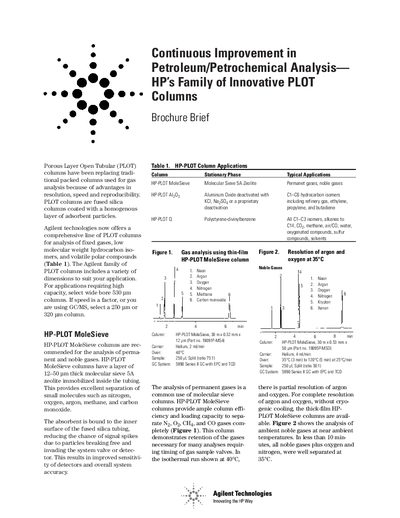
Agilent HP-PLOT Packed Column Brochure Brief
This document introduces the Agilent family of Porous Layer Open Tubular (PLOT) fused silica columns designed to replace traditional packed columns. These columns offer advantages in resolution, speed, and reproducibility for analyzing fixed gases, low molecular weight hydrocarbon isomers, and volatile polar compounds.
The brochure details two main families: HP-PLOT MoleSieve columns containing 5A zeolite for permanent and noble gas analysis, and HP-PLOT Al2O3 columns using aluminum oxide particles with various deactivation types (KCl, S, M) optimized for hydrocarbon isomer separation.
Agilent Al2O3 specifications
| Column Type | Fused silica columns coated with a homogenous layer of adsorbent particles |
|---|---|
| Al2O3 Column ID Range | 0.25 mm to 0.53 mm |
| Al2O3 Temperature Limit (0.32/0.53mm) | 200°C |
| Al2O3 Temperature Limit (0.25mm) | 250°C |
All Agilent Al2O3 documents by type
How to use the product for one specific task, with worked examples.
Questions answered in these manuals
Which HP-PLOT Al2O3 column is best for accurate quantitation of dienes?
The HP-PLOT Al2O3 KCl column is the choice for this application due to its low polarity.
What are the typical applications for HP-PLOT Al2O3 columns?
They are suitable for resolving C1-C6 hydrocarbon isomers in hydrocarbon streams.
How does the HP-PLOT column compare to Alumina/KCl columns?
HP-PLOT columns provide better selectivity and complete baseline separation, whereas Alumina/KCl columns often fail to separate critical impurities like cyclopropane from propylene.
From: Agilent HP-PLOT/Al2O3 Columns Application Note for C1-C6 Impurity Analysis
What is the retention index requirement for acetylene quantitation?
For the quantitation of acetylene, the retention index (RI) should be greater than 400 to prevent coelution with isobutane.
From: Agilent HP-PLOT/Al2O3 Columns Application Note for C1-C6 Impurity Analysis
What is the maximum operating temperature of the column?
The sodium sulfate deactivation provides a reproducible and stable selectivity up to 200 °C.
From: Agilent Detailed Separation of C1-C5 Light Hydrocarbons on CP-Al2O3/Na2SO4
Which compounds does the column retain more strongly?
The column retains unsaturated compounds such as ethylene, acetylene, and methyl acetylene more strongly than their saturated peers.
From: Agilent Detailed Separation of C1-C5 Light Hydrocarbons on CP-Al2O3/Na2SO4