
This document provides information on the source, structure, hazards, and testing methods of mycotoxins in food and feed. Mycotoxins are secondary metabolites of molds that contaminate crops and fruits, posing health risks to humans. The formation of mycotoxins is weather-dependent, making prevention challenging. More than 25% of global agricultural production is contaminated with mycotoxins, resulting in significant economic losses. Many countries have implemented regulations to limit mycotoxin exposure, impacting food and animal feed trade. Testing of raw materials and products is necessary to ensure the safety of food and feed. Current testing methods include gas chromatography with electron capture detection and gas chromatography-mass spectrometry.
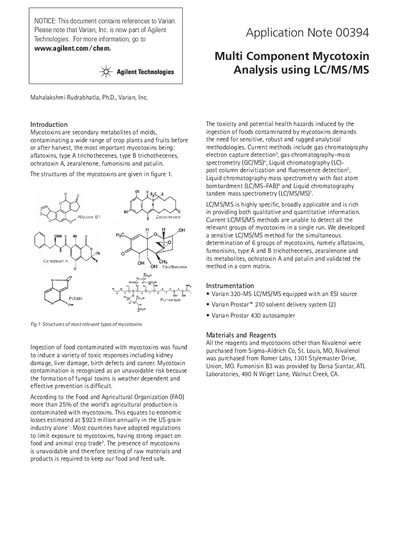
The document details a validated Liquid Chromatography-Tandem Mass Spectrometry (LC/MS/MS) method designed for the simultaneous detection of six groups of mycotoxins, including aflatoxins, fumonisins, trichothecenes, zearalenone, ochratoxin A, and patulin. The method was developed and validated using a corn matrix to ensure relevance for food safety testing.
The analysis utilizes an Agilent 320-MS instrument equipped with an ESI source and a Prostar solvent delivery system. The method achieves excellent sensitivity and selectivity, allowing for the detection of all 16 target mycotoxins in a single run without the need for prior sample cleanup. Performance data, including linearity, limits of quantitation (LOQ), and reproducibility, are provided and compared against FAO regulations.
| Instrument | Varian 320-MS LC/MS/MS |
|---|---|
| Solvent Delivery | Varian Prostar 210 |
| Autosampler | Varian Prostar 430 |
| Column | Polaris C-18A 5um, 150 mm x 3.0 mm ID |
| Injection Volume | 10 ul |
No, corn samples can be analyzed without any prior cleanup due to the high selectivity of the 320-MS.
The limit of quantitation (LOQ) for Aflatoxin B1 in solvent is 0.20 ppb.
Aflatoxins are detected in the positive mode.