
Key facts
Start here
Varian 385-LC Evaporative Light Scattering Detector Product Leaflet
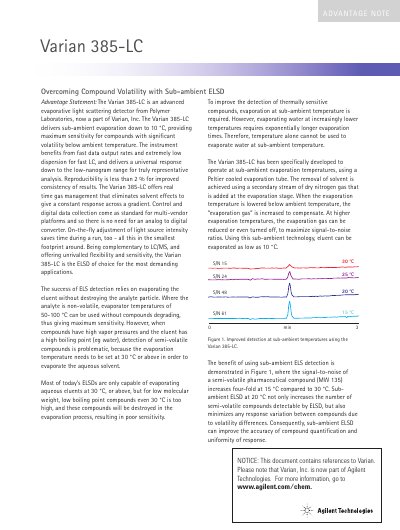
The Varian 385-LC is an advanced evaporative light scattering detector (ELSD) designed to overcome compound volatility. It features sub-ambient evaporation capabilities, utilizing a Peltier cooled evaporation tube and a secondary stream of dry nitrogen gas to evaporate eluents as low as 10°C. This technology allows for the detection of semi-volatile and low molecular weight compounds that would otherwise be destroyed at standard evaporation temperatures of 30°C or higher.
Read onlineAgilent 385-LC specifications
| Minimum evaporation temperature | 10 °C |
|---|---|
| Reproducibility | less than 2 % |
| Response range | low-nanogram range |
Source: Varian 385-LC Evaporative Light Scattering Detector Product Leaflet
All Agilent 385-LC documents by type
Mounting, wiring and first power-up. Read it before the hardware goes in.
Questions answered in these manuals
What is the minimum evaporation temperature for the Varian 385-LC?
The instrument can deliver sub-ambient evaporation down to 10 °C.
From: Varian 385-LC Evaporative Light Scattering Detector Product Leaflet
How does the Varian 385-LC handle aqueous solvents at low temperatures?
It uses a secondary stream of dry nitrogen gas added at the evaporation stage to remove solvent when the temperature is lowered.
From: Varian 385-LC Evaporative Light Scattering Detector Product Leaflet
What is the minimum evaporation temperature the Varian 385-LC can deliver?
The instrument delivers sub-ambient evaporation down to 10 °C.
From: Agilent 385-LC Series ELSD Food Analyses Applications Booklet
What is the maximum reproducibility rate stated for the Varian 385-LC?
Reproducibility is less than 2 % for improved consistency of results.
From: Agilent 385-LC Series ELSD Food Analyses Applications Booklet
What are the bench space requirements for the Agilent 385-LC?
The instrument requires a width of 20cm (8"), a depth of 45cm (18"), and a height of 42cm (17").
From: Agilent 385-LC Pre-Installation Site Preparation Checklist
What gas is required for the Agilent 385-LC operation?
The instrument requires Nitrogen with a purity of 98% or better, filtered to 0.2um.
From: Agilent 385-LC Pre-Installation Site Preparation Checklist