
Key facts
Start here
Agilent Protein 200 Plus LabChip Kit Assay Overview
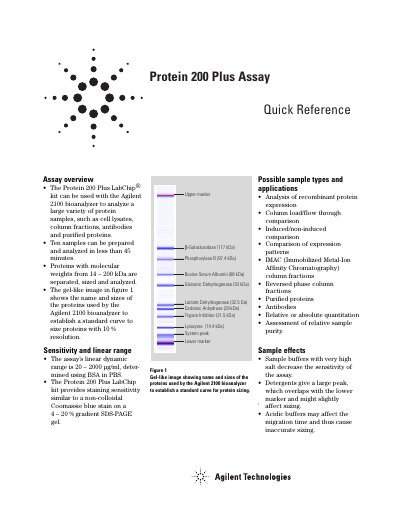
The Protein 200 Plus LabChip kit is designed for use with the Agilent 2100 bioanalyzer to analyze a wide variety of protein samples, including cell lysates, column fractions, antibodies, and purified proteins. It allows for the preparation and analysis of ten samples in less than 45 minutes, separating and sizing proteins with molecular weights ranging from 14 to 200 kDa with 10% resolution. The kit offers staining sensitivity comparable to a non-colloidal Coomassie blue stain on a 4-20% gradient SDS-PAGE gel, with a linear dynamic range of 20 to 2000 pg/ml determined using BSA in PBS.
The document outlines various possible sample types and applications, such as analysis of recombinant protein expression, comparison of column load and flow through, and assessment of relative sample purity. It also provides a detailed list of compatible protein sample buffers and buffer components, noting specific effects that may occur if certain buffers are used, such as large system peaks, marker displacement, or precipitation of SDS.
Agilent Protein 200 Plus specifications
| Molecular weight range | 14 — 200 kDa |
|---|---|
| Resolution | 10 % |
| Linear dynamic range | 20 — 2000 pg/ml |
| Sample throughput | Ten samples |
| Analysis time | less than 45 minutes |
All Agilent Protein 200 Plus documents by type
Questions answered in these manuals
What is the linear dynamic range of the Protein 200 Plus assay?
The assay's linear dynamic range is 20 — 2000 pg/ml, determined using BSA in PBS.
What is the sensitivity of the Protein 200 Plus assay compared to standard gels?
The kit provides staining sensitivity similar to a non-colloidal Coomassie blue stain on a 4 — 20 % gradient SDS-PAGE gel.
What is the typical sizing accuracy for the Protein 200 Plus assay?
The results are typically within 20% C.V. of the expected value.
What is the minimum detectable concentration for BSA in PBS?
The assay can detect 20 pg/mL of BSA in PBS with a good signal-to-noise ratio.