
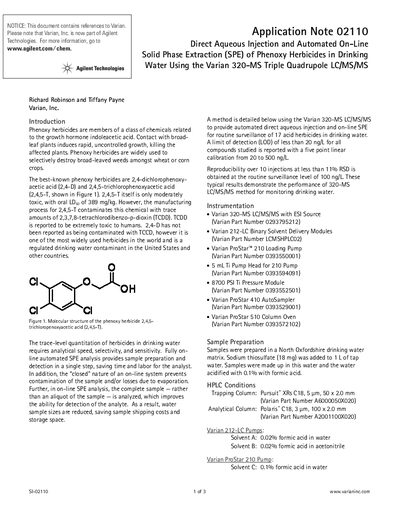
This article describes the application of Varian's 320-MS triple quadrupole LC/MS/MS system in the direct aqueous injection and automated on-line solid phase extraction (SPE) analysis of phenoxy herbicides in drinking water. Phenoxy herbicides are a class of chemicals related to the growth hormone indoleacetic acid. Contact with broad-leaf plants induces rapid, uncontrolled growth, killing the affected plants. Phenoxy herbicides are widely used to selectively destroy broad-leaved weeds amongst wheat or corn crops. The best-known phenoxy herbicides are 2,4-dichlorophenoxy-acetic acid (2,4-D) and 2,4,5-trichlorophenoxyacetic acid (2,4,5-T). 2,4,5-T itself is only moderately toxic, with an oral LD50 of 389 mg/kg. However, the manufacturing process for 2,4,5-T contaminates this chemical with trace amounts of 2,3,7,8-tetrachlorodibenzo-p-dioxin (TCDD), which is reported to be extremely toxic to humans. 2,4-D has not been reported as being contaminated with TCDD, however it is one of the most widely used herbicides in the world and is a regulated drinking water contaminant in the United States and other countries.
The document describes an analytical method designed to quantify 17 acid herbicides, specifically phenoxy herbicides like 2,4-D and Dicamba, in drinking water samples. The technique utilizes fully automated on-line solid phase extraction (SPE) coupled with direct aqueous injection into the Agilent 320-MS Triple Quadrupole LC/MS/MS system.
The method achieves a limit of detection of less than 20 ng/L for all compounds studied, utilizing a five-point linear calibration range from 20 to 500 ng/L. Reproducibility over ten injections at the routine surveillance level of 100 ng/L is reported to be better than 11% RSD.
| Limit of Detection (LOD) | < 20 ng/L for all compounds studied |
|---|---|
| Calibration Range | 20 to 500 ng/L |
| Reproducibility (RSD) | < 11% at 100 ng/L |
| Run Time | 26 minutes |
The limit of detection (LOD) is less than 20 ng/L for all compounds studied.
The method uses a five-point linear calibration ranging from 20 to 500 ng/L.
The method separates and quantifies 17 acid herbicides in drinking water.