
This paper introduces a method for detecting low levels of tylosin using a 320-MS triple quadrupole mass spectrometer. This method can accurately detect and quantify tylosin over a wide concentration range and below EU required tolerance limits.
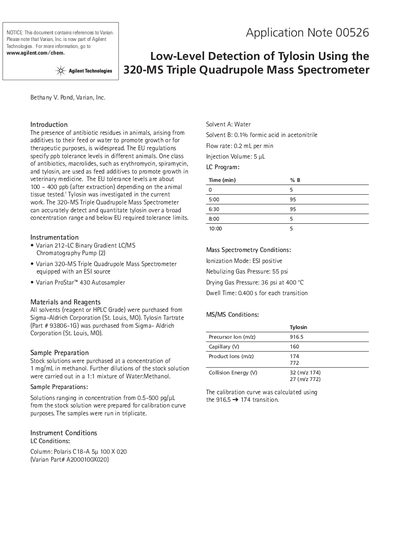
This document details the use of the Agilent 320-MS Triple Quadrupole Mass Spectrometer for detecting antibiotic residues, specifically tylosin, in animal tissues. The study demonstrates that the instrument can accurately detect and quantitate tylosin at concentrations well below EU regulatory tolerance limits (0.2 pg/L limit of detection and 0.5 pg/L limit of quantitation).
The note provides specific instrument conditions for Liquid Chromatography (LC) and Mass Spectrometry (MS), including column type, solvent gradients, and MS/MS transition parameters (916.5 > 174 m/z). It also presents data on reproducibility, showing retention time and area reproducibility over 20 consecutive injections.
| Limit of Detection (LOD) | 0.2 pg/L |
|---|---|
| Limit of Quantitation (LOQ) | 0.5 pg/L |
| Precursor Ion (m/z) | 916.5 |
| Product Ion (m/z) | 174 |
| Collision Energy (m/z 174) | 32 V |
| Flow rate | 0.2 mL per min |
| Injection Volume | 5 pL |
The limit of detection (LOD) is 0.2 pg/L.
The limit of quantitation (LOQ) is 0.5 pg/L.
The calibration uses the 916.5 > 174 transition with a collision energy of 32 V.