
Key facts
- Brand
- Agilent
- Model
- 300EXTEND-C18
- Industry
- Industrial
- Documents
- 3
- Languages
- EN
- Last added
- 2012-07-04
Start here
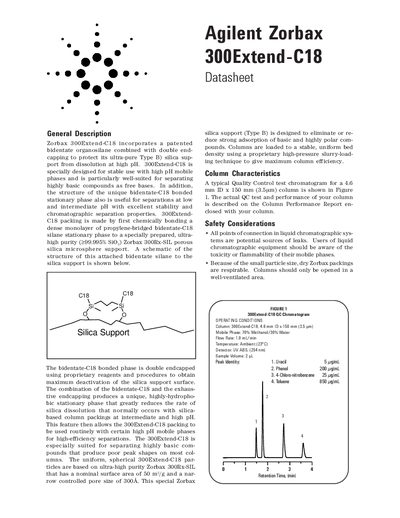
Agilent Zorbax 300Extend-C18 HPLC Column Datasheet
The Agilent Zorbax 300Extend-C18 is a reversed-phase HPLC packing designed for stable use with high pH mobile phases. It incorporates a patented bidentate organosilane combined with double end-capping to protect the ultra-pure Type B silica support from dissolution at high pH levels.
This column is particularly well-suited for separating highly basic compounds as free bases, offering excellent stability and chromatographic separation properties across low, intermediate, and high pH ranges. The uniform spherical particles are based on a specially prepared Zorbax 300Rx-SIL porous silica microsphere support with a nominal surface area of 50 m²/g.
Agilent 300EXTEND-C18 specifications
| Silica Support Type | Ultra-pure Type B silica |
|---|---|
| Nominal Surface Area | 50 m²/g |
| Pore Size | 300 Angstroms |
| Carbon Content | about 4% |
| Maximum Operating Temperature | 60°C |
| Optimum Operating pH Range | pH 2 - 11.5 |
All Agilent 300EXTEND-C18 documents by type
Ratings, dimensions and ordering codes, for selection and design work.
Questions answered in these manuals
What is the maximum pH limit for this column?
The column has been used up to pH 11.5 with good results, provided certain operating parameters are followed.
Which organic buffers are recommended for high pH applications?
Organic buffers such as pyrrolidine, triethylamine, and 1-methyl-piperidine are recommended because carbonate and phosphate buffers should be avoided.
What is the main advantage of ZORBAX Poroshell 300Extend-C18?
It permits up to five times faster separation of peptides and proteins over columns using totally porous silica packing.
From: Agilent ZORBAX Poroshell 300Extend-C18 High-pH Separation Application
Why is high pH separation desirable?
High pH may be desirable for improving selectivity, solubility, ease of downstream processing, or to change signal-to-noise and charge-state in LC/MS.
From: Agilent ZORBAX Poroshell 300Extend-C18 High-pH Separation Application
What is the advantage of using NH4OH over TFA in LC/MS?
Using NH4OH can lead to reduced background noise and a higher signal-to-noise (S/N) ratio compared to TFA or formic acid.
From: Agilent ZORBAX Poroshell 300Extend-C18 LC/MS Application Note
How does the charge state distribution change with high pH?
The dominant ion shifts from +2 in TFA conditions to +3 in NH4OH conditions.
From: Agilent ZORBAX Poroshell 300Extend-C18 LC/MS Application Note