
Key facts
- Brand
- Analog Devices
- Model
- AD7701
- Industry
- Industrial
- Documents
- 3
- Languages
- EN
- Last added
- 2012-08-02
Start here
ANALOG DEVICES AN-368 handbook
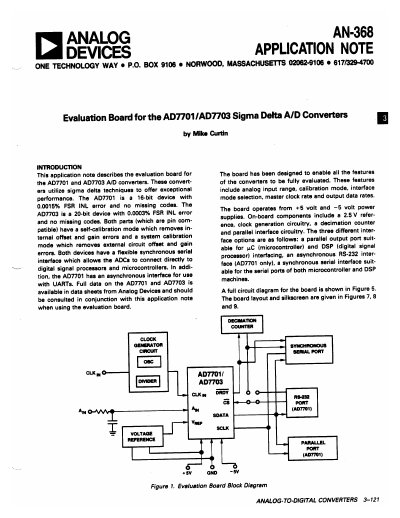
The document details an evaluation board designed for the AD7701 (a 16-bit device) and AD7703 (a 20-bit device), which utilize sigma delta techniques. The board supports various interface modes including synchronous serial, asynchronous RS-232, and parallel output, allowing connection to microcontrollers and DSPs.
Read onlineAnalog Devices AD7701 specifications
| AD7701 Resolution | 16-bit |
|---|---|
| AD7703 Resolution | 20-bit |
| AD7701 INL Error | 0.0015% FSR |
| AD7703 INL Error | 0.0003% FSR |
| On-board Reference Voltage | 2.5 V |
| Clock Frequency (INT) | 4.9152 MHz |
Source: ANALOG DEVICES AN-368 handbook
All Analog Devices AD7701 documents by type
Ratings, dimensions and ordering codes, for selection and design work.
How to use the product for one specific task, with worked examples.
Questions answered in these manuals
What is the output update rate for a 4.096 MHz input clock?
The output update rate is 4 kHz.
What is the maximum baud rate available for the asynchronous interface?
The maximum baud rate is 19200.
What is the resolution of the AD7701LC2MOS?
The AD7701LC2MOS provides a 16‑bit resolution.
From: Analog Devices AD7701LC2MOS 16‑Bit A/D Converter Datasheet
Can the AD7701 operate with an external clock?
Yes, the device can use an external clock up to 55 MHz; the typical internal clock is 4.096 MHz.
From: Analog Devices AD7701LC2MOS 16‑Bit A/D Converter Datasheet
What is the maximum output data rate of the AD7701?
The AD7701 can output data at up to 4 kSPS.
How much power does the AD7701 consume in standby mode?
In standby the device typically consumes only 10 µW, with a maximum of 20 pW.