
Key facts
- Brand
- Analog Devices
- Model
- AD9880
- Industry
- Industrial
- Documents
- 2
- Languages
- EN
- Last added
- 2012-05-09
Start here
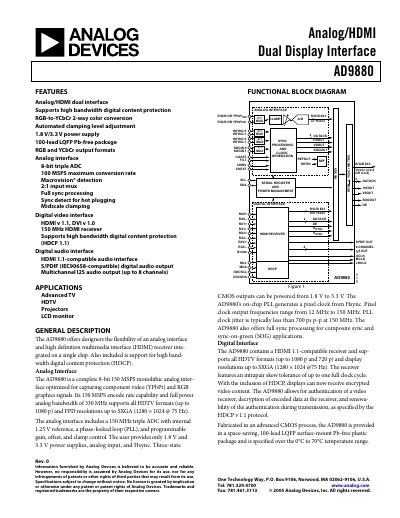
Analog Devices AD9880 Datasheet
The AD9880 provides designers with a single‑chip solution that combines an analog video interface and an HDMI 1.1‑compatible receiver. It supports high‑bandwidth digital content protection (HDCP 1.1), RGB‑to‑YCbCr 4:4:4 or 4:2:2 conversion, and up to eight‑channel I²S audio output. The analog front‑end captures component video (YPbPr) and RGB signals with a 150 MSPS 8‑bit ADC, while the digital side handles HDMI/DVI video, audio, and HDCP authentication.
Key electrical characteristics include a 1.8 V/3.3 V dual‑supply, a maximum pixel‑clock of 150 MHz, and operation over a 0 °C to 70 °C temperature range. The device is offered in a 100‑lead LQFP Pb‑free package and includes extensive pin‑out and register maps for flexible configuration.
Analog Devices AD9880 specifications
| Resolution | 8 bits |
|---|---|
| HDMI Receiver Compatibility | HDMI 1.1 |
| HDCP Support | HDCP 1.1 |
Source: Analog Devices AD9880 Datasheet
All Analog Devices AD9880 documents by type
Ratings, dimensions and ordering codes, for selection and design work.
Questions answered in these manuals
What power supplies does the AD9880 require?
The AD9880 operates from two supplies: 1.8 V for DVDD/PVDD and 3.3 V for VDD.
What is the maximum pixel‑clock frequency of the AD9880?
The pixel‑clock can be generated up to 150 MHz.
What power supplies are required for the AD9880?
The device needs 1.8 V or 3.3 V analog power supplies, with separate digital supply rails; typical Vop is 3.3 V and DVpp is 1.8 V.
What is the maximum pixel‑clock frequency the chip can generate?
The on‑chip PLL can generate pixel clocks from 12 MHz up to 150 MHz.