
Key facts
- Brand
- Analog Devices
- Model
- AN-333
- Industry
- Computers
- Documents
- 2
- Languages
- EN
- Last added
- 2012-08-02
Start here
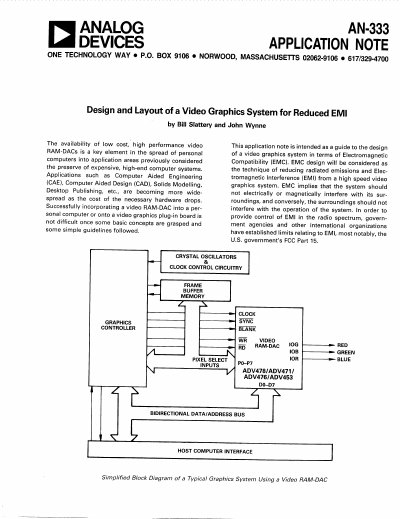
Analog Devices AN-333 Application Note Design and Layout of a Video Graphics System for Reduced EMI
This document serves as a guide for designers creating video graphics systems, specifically focusing on minimizing Electromagnetic Compatibility (EMC) issues. It addresses the challenges of incorporating low-cost, high-performance Video RAM-DACs into personal computers or plug-in boards while adhering to regulatory limits like FCC Part 15.
The text identifies key noise sources within such systems, including crystal oscillators, fast transition logic circuits, unterminated lines, stray inductance/capacitance, and switching power supplies. It offers specific strategies for mitigating these issues through careful component placement, isolation techniques (such as using ferrite beads), and the selection of appropriate logic families with slower rise/fall times.
All Analog Devices AN-333 documents by type
How to use the product for one specific task, with worked examples.
Questions answered in these manuals
How should crystal oscillator circuits be placed to reduce EMI?
They should be placed as far as possible from analog circuitry and video output connectors.
From: Analog Devices AN-333 Application Note Design and Layout of a Video Graphics System for Reduced EMI
What is the maximum permissible radiation field strength for a Class B computing device between 30 MHz and 88 MHz at a distance of 3 meters?
The maximum permissible radiation field strength is 100 uV/Meter.
From: Analog Devices AN-333 Application Note Design and Layout of a Video Graphics System for Reduced EMI
What is the maximum permissible radiated electric field strength for a Class B computing device at frequencies between 30 MHz and 88 MHz?
The limit is 100 uV/Meter when measured at a distance of 3 meters.
From: Analog Devices AN-333 Application Note Design and Layout of a Video Graphics System for Reduced EMI