
Key facts
- Brand
- Analog Devices
- Model
- ADSP-216X
- Industry
- Industrial
- Documents
- 2
- Languages
- EN
- Last added
- 2012-08-03
Start here
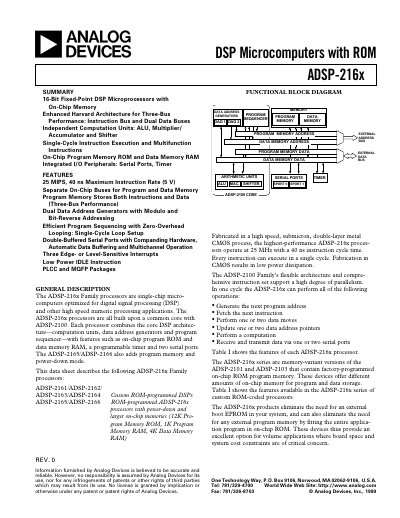
Analog Devices ADSP-216x DSP Microcomputers Datasheet
The ADSP-216x family consists of single-chip microcomputers optimized for digital signal processing and high-speed numeric applications. Built upon the ADSP-2100 core, these processors feature an enhanced Harvard architecture with three independent buses, allowing for single-cycle instruction execution and parallel operations. The family includes various models with different amounts of on-chip program ROM and data RAM, eliminating the need for external boot memory in many applications.
Read onlineAnalog Devices ADSP-216X specifications
| Data Memory (RAM) | 1/2K to 4K |
|---|---|
| Program Memory (ROM) | 4K to 12K |
| Maximum Instruction Rate | 25 MIPS |
| Instruction Cycle Time | 40 ns |
| Supply Voltage | 3.3 V or 5 V |
| Temperature Grades | Commercial (0°C to +70 °C) or Industrial (-40°C to +85 °C) |
Source: Analog Devices ADSP-216x DSP Microcomputers Datasheet
All Analog Devices ADSP-216X documents by type
Ratings, dimensions and ordering codes, for selection and design work.
Questions answered in these manuals
What is the maximum instruction rate of the ADSP-216x processors?
The maximum instruction rate is 25 MIPS at 5 V.
Do the ADSP-216x processors require external boot memory?
No, they can eliminate the need for an external boot EPROM by fitting the entire application program in on-chip ROM.
What is the maximum instruction rate of the ADSP-216x?
The ADSP-216x can achieve up to 25 MIPS with a 40 ns instruction cycle at 5 V.
How many serial ports does the ADSP-216x provide?
Each ADSP-216x processor includes two synchronous serial ports, SPORT0 and SPORT1.