
The document provides information about ADSP-216x, a 16-bit fixed-point DSP microprocessor with on-chip memory and enhanced Harvard architecture. It also highlights features and characteristics such as single-cycle instruction execution, multifunction instructions, and integrated I/O peripherals.
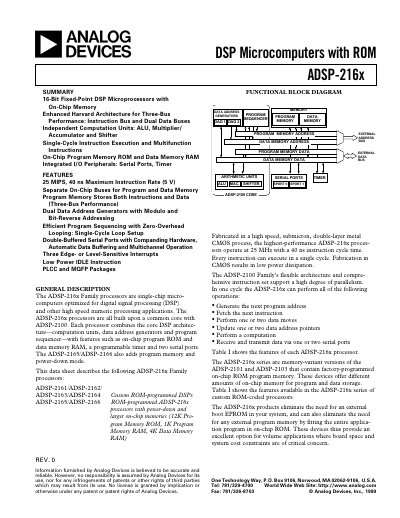
The ADSP-216x family consists of single-chip microcomputers optimized for digital signal processing and high-speed numeric applications. Built upon the ADSP-2100 core, these processors feature an enhanced Harvard architecture with three independent buses, allowing for single-cycle instruction execution and parallel operations. The family includes various models with different amounts of on-chip program ROM and data RAM, eliminating the need for external boot memory in many applications.
| Data Memory (RAM) | 1/2K to 4K |
|---|---|
| Program Memory (ROM) | 4K to 12K |
| Maximum Instruction Rate | 25 MIPS |
| Instruction Cycle Time | 40 ns |
| Supply Voltage | 3.3 V or 5 V |
| Temperature Grades | Commercial (0°C to +70 °C) or Industrial (-40°C to +85 °C) |
The maximum instruction rate is 25 MIPS at 5 V.
No, they can eliminate the need for an external boot EPROM by fitting the entire application program in on-chip ROM.
The architecture includes three independent computational units: the ALU, the multiplier/accumulator (MAC), and the shifter.