
ADSP-216x is a 16-bit fixed-point DSP microprocessor with enhanced Harvard architecture and three-bus performance. It features independent computation units, single-cycle instruction execution, and multifunction instructions. It also integrates serial ports, a timer, and other I/O peripherals.
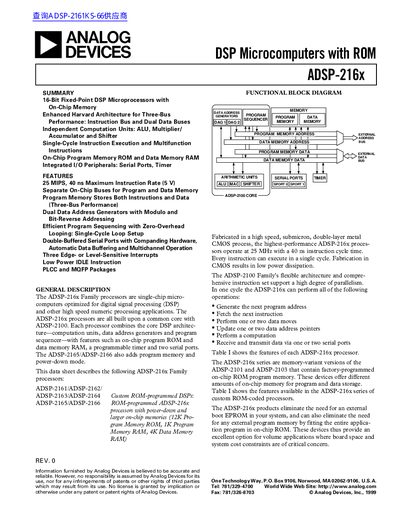
The ADSP-216x family are 16‑bit fixed‑point DSP microprocessors with on‑chip ROM and RAM, dual data address generators, and two synchronous serial ports. They deliver up to 25 MIPS at 40 ns instruction cycle time (5 V) and are offered in PLCC and MQFP packages.
The datasheet details architecture, pin functions, clock and reset requirements, interrupt handling, and development tool support, providing designers with the information needed to integrate these processors into high‑speed numeric applications.
| Processor type | 16‑bit Fixed‑Point DSP Microprocessor |
|---|---|
| Maximum instruction rate | 25 MIPS, 40 ns (5 V) |
| Supply voltage options | 5 V or 3.3 V |
| Data memory (RAM) | 1 KB/2 KB (2161‑2164) or 4 KB (2165‑2166) |
| Program memory (ROM) | 8 KB (2161‑2162) or 4 KB (2163‑2164) or 12 KB (2165‑2166) |
| Serial ports | Two synchronous serial ports (SPORT0, SPORT1) |
The ADSP-216x can achieve up to 25 MIPS with a 40 ns instruction cycle at 5 V.
Each ADSP-216x processor includes two synchronous serial ports, SPORT0 and SPORT1.
The devices operate from either a 5 V or a 3.3 V supply, depending on the model.