
Key facts
- Brand
- Analog Devices
- Model
- AD1974
- Industry
- Industrial
- Documents
- 3
- Languages
- EN
- Last added
- 2012-08-02
Start here
ANALOG DEVICES UG-046 handbook
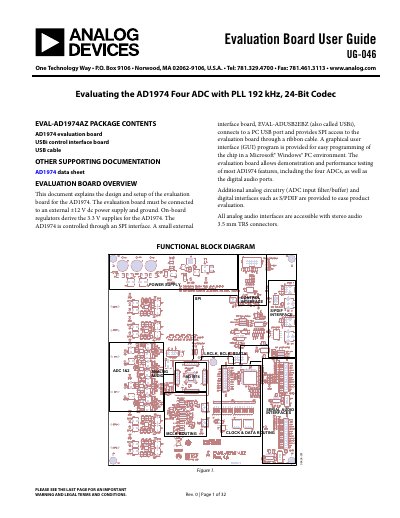
This document provides instructions for the AD1974 evaluation board, covering package contents, functional block diagrams, and setup procedures. The board requires an external ±12 V dc power supply and allows the AD1974 to be controlled via an SPI interface connected to a PC through a USBi control interface board.
Read onlineAnalog Devices AD1974 specifications
| ADC Resolution | 24 bits |
|---|---|
| Full‑Scale Differential Input Voltage | 1.9 Vrms |
| Supply Voltages (AVDD, DVDD) | 3.3 V (typical) |
| Operating Temperature Range (case) | -40 °C to +125 °C |
| Dynamic Range (with A‑Weighted Filter) | 100 dB (typ) |
| Total Harmonic Distortion + Noise (THD+N) | -96 dB to -87 dB |
| Master Clock Frequency | 12.288 MHz |
| Package | 48‑lead LQFP |
Source: Analog Devices AD1974 Datasheet
All Analog Devices AD1974 documents by type
Day-to-day operation, settings and troubleshooting. Start here if the product is already set up.
Ratings, dimensions and ordering codes, for selection and design work.
Questions answered in these manuals
What power supply voltage is required to operate the evaluation board?
The board requires a power supply input of ±12 V dc and ground connected to the three binding posts.
How much current does the +12 V power input draw?
The +12 V input draws approximately 250 mA.
What supply voltage does the AD1974 require?
The AD1974 operates from a single 3.3 V supply for both analog and digital sections.
How many ADC channels are included in the AD1974?
The device contains four analog‑to‑digital converters (ADCs).