
Key facts
- Brand
- Analog Devices
- Model
- AD7878
- Industry
- Industrial
- Documents
- 3
- Languages
- EN
- Last added
- 2012-08-02
Start here
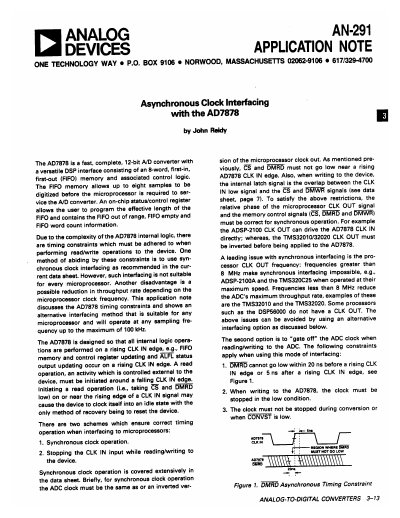
Analog Devices AN-291 Application Note Asynchronous Clock Interfacing with the AD7878
The document discusses timing constraints for the AD7878, a 12-bit A/D converter with a FIFO memory. It explains that while synchronous clock interfacing is recommended in the data sheet, it is not suitable for every microprocessor and may reduce throughput. An alternative asynchronous method is presented that allows operation at any sampling frequency up to 100 kHz.
Read onlineAnalog Devices AD7878 specifications
| Resolution | 12-bit |
|---|---|
| FIFO Memory | 8-word |
| Maximum Sampling Frequency | 100 kHz |
Source: Analog Devices AN-291 Application Note Asynchronous Clock Interfacing with the AD7878
All Analog Devices AD7878 documents by type
Ratings, dimensions and ordering codes, for selection and design work.
How to use the product for one specific task, with worked examples.
Questions answered in these manuals
What is the maximum sampling frequency for the AD7878?
The device can operate at any sampling frequency up to the maximum of 100 kHz.
From: Analog Devices AN-291 Application Note Asynchronous Clock Interfacing with the AD7878
Why use asynchronous interfacing instead of synchronous?
Synchronous interfacing is not suitable for every microprocessor and may reduce throughput depending on the clock frequency.
From: Analog Devices AN-291 Application Note Asynchronous Clock Interfacing with the AD7878
What is the maximum data access time of the AD7878?
The maximum data access time is 41 ns.
From: Analog Devices AD7878 12-Bit 100 kHz Sampling ADC Datasheet
What is the input voltage range for the AD7878?
The analog input has a bipolar range of ±3 V.
From: Analog Devices AD7878 12-Bit 100 kHz Sampling ADC Datasheet
What is the data access time of the AD7878?
The maximum data access time is 41 ns.
How much power does the AD7878 typically consume?
Typical power consumption is 60 mW.