
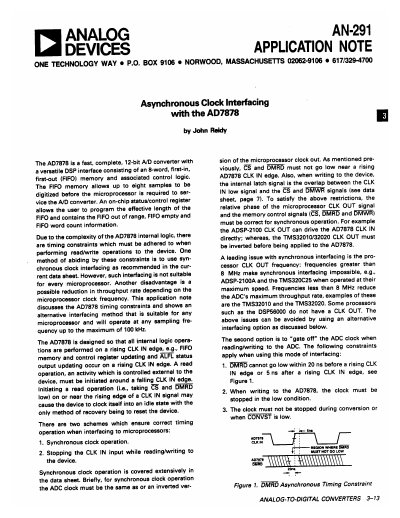
Analog Devices AN-291 Application Note Asynchronous Clock Interfacing with the AD7878


Analog Devices AN-291 Application Note Asynchronous Clock Interfacing with the AD7878 - cover page
Brand
Analog Devices
Category
Other Electronics
Document type
Application Note
Language
English
Pages
2
File format
PDF
File size
138 KB
Published
02 August, 2012
Updated
22 August, 2012
Model
AD7878
MD5 checksum
BD462CC331AC61FA86B9AF0DCFF2F4A4

About this manual

The document discusses timing constraints for the AD7878, a 12-bit A/D converter with a FIFO memory. It explains that while synchronous clock interfacing is recommended in the data sheet, it is not suitable for every microprocessor and may reduce throughput. An alternative asynchronous method is presented that allows operation at any sampling frequency up to 100 kHz.

What's inside

  • Asynchronous Clock Interfacing
  • Timing Constraints
  • Synchronous vs Asynchronous Operation
  • AD7878 FIFO Memory
  • Processor Interface Examples
  • DMRD Delay Calculation

Specifications

Resolution12-bit
FIFO Memory8-word
Maximum Sampling Frequency100 kHz

Frequently asked questions

What is the maximum sampling frequency for the AD7878?

The device can operate at any sampling frequency up to the maximum of 100 kHz.

Why use asynchronous interfacing instead of synchronous?

Synchronous interfacing is not suitable for every microprocessor and may reduce throughput depending on the clock frequency.

Download PDF (138 KB)

More Analog Devices Manuals


View all Analog Devices manuals →