
Key facts
- Brand
- Agilent
- Model
- DNA 1000
- Documents
- 3
- Languages
- EN
- Last added
- 2012-07-03
Start here
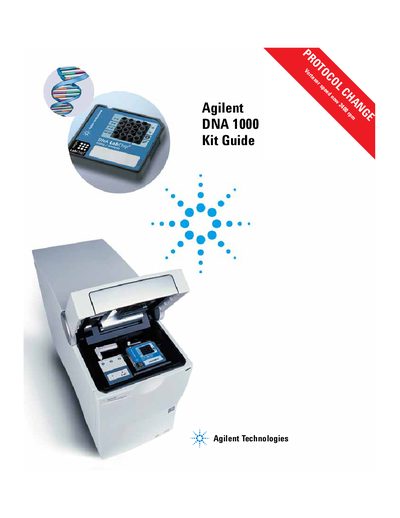
Agilent DNA 1000 Kit Guide
The document serves as a user manual for the Agilent DNA 1000 Kit, detailing the procedures required to perform DNA analysis. It covers the necessary equipment, including the Chip Priming Station and Vortex Mixer, alongside the Agilent 2100 Bioanalyzer.
The guide outlines specific protocols for preparing reagents such as the Gel-Dye Mix, Marker, Ladder, and Samples. It further instructs users on setting up the assay equipment, loading the chip, running the analysis via Expert software, cleaning electrodes, and interpreting the resulting electropherograms.
Agilent DNA 1000 specifications
| Size range (DNA 500) | 25 to 500 base pairs |
|---|---|
| Size range (DNA 1000) | 25 to 1000 base pairs |
| Resolution (DNA 500, 25-100 bp) | 5 base pairs |
| Resolution (DNA 500, 100-500 bp) | 5 % |
| Resolution (DNA 1000, 500-1000 bp) | 10 % |
Source: Agilent DNA 500 and DNA 1000 LabChip Kits Application Note
All Agilent DNA 1000 documents by type
How to use the product for one specific task, with worked examples.
Day-to-day operation, settings and troubleshooting. Start here if the product is already set up.
Questions answered in these manuals
What are the applications for the DNA 500 and DNA 1000 kits?
They are especially useful for small to medium sized PCR and RT-PCR products, can resolve primer dimers, and apply to competitive PCR and cleavage based applications such as RFLP.
From: Agilent DNA 500 and DNA 1000 LabChip Kits Application Note
How does the resolution of the DNA 500 kit compare below 100 bp?
The resolution in the lower range, i.e. below 100 bp, is significantly increased compared to other DNA LabChip kits.
From: Agilent DNA 500 and DNA 1000 LabChip Kits Application Note
What is the sizing range for this kit?
The sizing range covers DNA fragments from 25 to 1000 base pairs (bp).
What is the quantitative range of the assay?
The quantitative range is from 0.1 to 50 ng/ul.