
Key facts
Start here
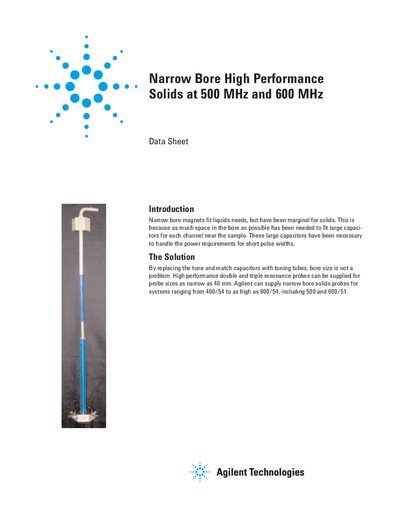
Agilent Narrow Bore High Performance Solids at 500 MHz and 600 MHz Data Sheet
Agilent Technologies provides narrow bore high performance solids probes designed for NMR systems ranging from 400/54 to 900/54, specifically including 500 and 600 MHz models. These probes utilize tuning tubes to maximize bore size, enabling high performance double and triple resonance capabilities for rotor diameters from 2.5 to 6 mm. They are intended for protein structure determination and the study of membrane proteins using standard amplifiers.
Read onlineAgilent 600MHz specifications
| Probe Types | HX double resonance or HXY triple resonance |
|---|---|
| Rotor Diameters | 2.5 to 6 mm |
| Spinning Module Size | 3.2 mm |
| S/N (Double Resonance) | 100:1 to 140:1 |
Source: Agilent Narrow Bore High Performance Solids at 500 MHz and 600 MHz Data Sheet
All Agilent 600MHz documents by type
Ratings, dimensions and ordering codes, for selection and design work.
How to use the product for one specific task, with worked examples.
Questions answered in these manuals
What are the available probe configurations?
Agilent offers 500 HX, 500 HXY, 600 HX, and 600 HXY configurations.
From: Agilent Narrow Bore High Performance Solids at 500 MHz and 600 MHz Data Sheet
What is the tuning range for these probes?
The tuning range covers 1H, 31P, and 15N.
From: Agilent Narrow Bore High Performance Solids at 500 MHz and 600 MHz Data Sheet
What is the key advantage of combining SOFAST with cold probes?
It allows the recording of 2-D NMR spectra of proteins in less than 10 sec, lowering the barrier to real-time investigation of dynamic events.
From: Agilent Ultra-fast NMR Spectroscopy in Cold Probes Application Note
How long does the total experimental time take for the SOFAST-HMQC experiment on cytochrome C?
The total experimental time is 6 seconds.
From: Agilent Ultra-fast NMR Spectroscopy in Cold Probes Application Note