
Key facts
Start here
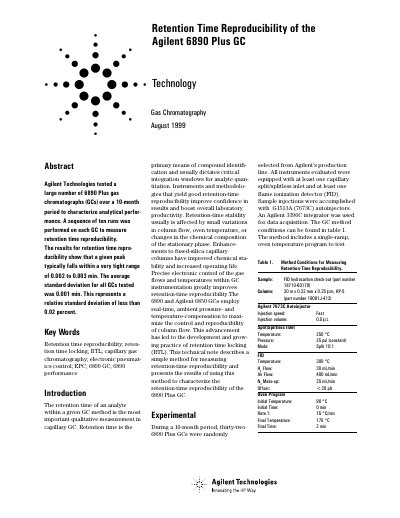
Agilent 6890 Plus GC Retention Time Reproducibility Technical Note
Agilent Technologies tested thirty-two 6890 Plus gas chromatographs over a 10-month period to characterize their analytical performance regarding retention time reproducibility. The study utilized a sequence of ten automated runs on each instrument using a hydrocarbon check-out sample and an Agilent 3396C integrator for data acquisition.
The results indicate that the electronic pneumatics control with real-time ambient pressure- and temperature-compensation significantly improves stability. For the C16 peak, retention times typically fell within a narrow range of 0.002 to 0.003 minutes. The average standard deviation across all tested GCs was 0.001 minute, representing a relative standard deviation (RSD) of less than 0.02 percent.
Agilent 6890Plus GC specifications
| Injection Port Temperature | 300°C |
|---|---|
| Pulse Pressure & Time | 25.0 psi 1.00 min |
| Purge Flow & Time | 20.0 mL/min 3.00 min |
| Gas Saver Flow & Time | 20.0 mL/min 3.00 min |
| Initial Flow & Mode | 1.2 mL/min Constant Flow |
| MSD Transfer Line Temp | 325°C |
Source: Agilent A New Approach to the Analysis of Phthalate Esters by GC/MS Application Note
All Agilent 6890Plus GC documents by type
How to use the product for one specific task, with worked examples.
Questions answered in these manuals
What is the typical range for retention time reproducibility on this GC?
A given peak typically falls within a very tight range of 0.002 to 0.003 min.
From: Agilent 6890 Plus GC Retention Time Reproducibility Technical Note
What is the average standard deviation for all tested GCs?
The average standard deviation for all GCs tested was 0.001 min.
From: Agilent 6890 Plus GC Retention Time Reproducibility Technical Note
What is the maximum relative standard deviation for retention time reproducibility?
The relative standard deviation is below 0.05 percent for all instruments with and without the insert.
Which reagent gas is recommended for reducing chemical noise in phthalate analysis?
Ammonia is recommended as the reagent gas to reduce chemical noise and enhance identification.
From: Agilent A New Approach to the Analysis of Phthalate Esters by GC/MS Application Note
What is the primary benefit of using retention-time locking (RTL)?
RTL allows for the creation of compound acquisition methods and quantitation databases that can be reproduced in any laboratory anywhere.
From: Agilent A New Approach to the Analysis of Phthalate Esters by GC/MS Application Note