
Key facts
- Brand
- Agilent
- Model
- 6890 Series GC
- Documents
- 3
- Languages
- EN
- Last added
- 2012-07-02
Start here
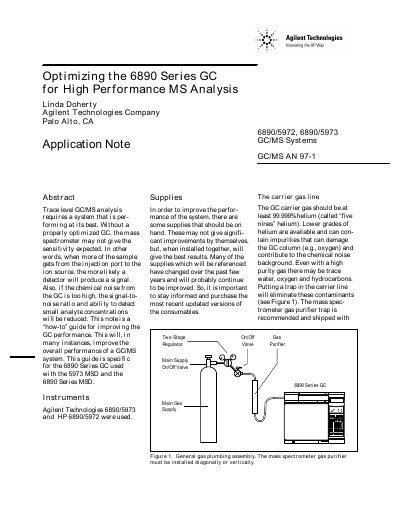
Agilent Technologies Optimizing the 6890 Series GC for High Performance Application Note
The document serves as a "how-to" guide for improving the performance of an Agilent 6890 Series GC used with a 5973 MSD. It focuses on optimizing the gas plumbing, inlet system, and column connections to enhance sensitivity and reduce chemical noise.
Key recommendations include using high-purity helium (≥99.999%), installing mass spectrometer gas purifier traps vertically or diagonally, and utilizing specific consumables like single tapered deactivated liners and Merlin Microseal™ septum systems. The text also details the proper installation of column nuts and ferrules to ensure leak-tight seals.
Agilent 6890 Series GC specifications
| Carrier gas purity requirement | at least 99.999% helium |
|---|---|
| Recommended column dimensions for trace analysis | 30 m, 0.25 mm ID, 0.25 µm film |
| Recommended septum replacement frequency | every 100 injections |
Source: Agilent Technologies Optimizing the 6890 Series GC for High Performance Application Note
All Agilent 6890 Series GC documents by type
How to use the product for one specific task, with worked examples.
- Agilent Technologies Optimizing the 6890 Series GC for High Performance Application Note 11 p
- Agilent 6890 Series GC Micro-ECD Validation Analysis of EPA CLP Target Organochlorine Pesticides 8 p
- Agilent Improved Analysis of Sulfur Nitrogen Other Heteroatomic Compounds in Gasoline- Diesel-Range Materials Using GC/Atomic Emission Detection (Application Note 228-394) 12 p
Questions answered in these manuals
What is the minimum purity required for GC carrier gas?
The carrier gas must be at least 99.999% helium to prevent impurities from damaging the column.
From: Agilent Technologies Optimizing the 6890 Series GC for High Performance Application Note
How should the mass spectrometer gas purifier trap be installed?
It must be installed diagonally or vertically for optimum performance and never horizontally.
From: Agilent Technologies Optimizing the 6890 Series GC for High Performance Application Note
What sample volumes and extraction methods are used for water and soil samples?
A 1-L volume of water is extracted with methylene chloride, while a 30-g aliquot of soil is extracted with a 1:1 acetone/methylene chloride mixture.
From: Agilent 6890 Series GC Micro-ECD Validation Analysis of EPA CLP Target Organochlorine Pesticides
What are the specific concentrations used for the three-point initial calibration of lindane?
The initial calibration uses standards of 5, 20, and 80 pg/L for lindane.
From: Agilent 6890 Series GC Micro-ECD Validation Analysis of EPA CLP Target Organochlorine Pesticides
What types of fuels can be analyzed using this method?
The method is applicable to low-sulfur gasoline and diesel fuels, as well as other light gas oil fractions with final boiling points of approximately C25 (402 °C, 756 °F).
What are the specific wavelengths used for detecting carbon, sulfur, nitrogen, oxygen, lead, manganese, and fluorine?
The system uses 179 nm for carbon, 181 nm for sulfur, 388 nm for nitrogen, 171 nm for oxygen, 261 nm for lead, 259 nm for manganese, and 690 nm for fluorine.