
This document introduces the Philips P4688 LED lamp. The lamp features Philips' unique CoreLED light source technology, which provides high brightness, high color rendering, and long life. The P4688 LED lamp also has an intelligent energy-saving function that automatically adjusts the light output according to the ambient light level, helping to save energy.
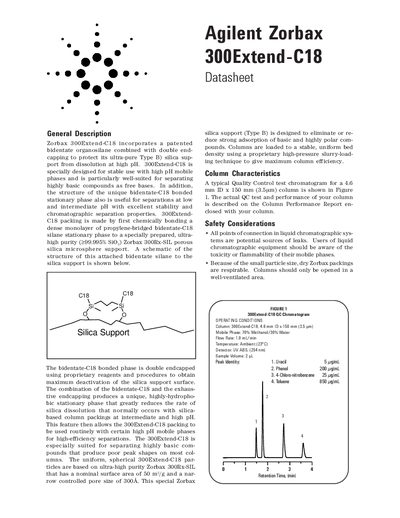
The Agilent Zorbax 300Extend-C18 is a reversed-phase HPLC packing designed for stable use with high pH mobile phases. It incorporates a patented bidentate organosilane combined with double end-capping to protect the ultra-pure Type B silica support from dissolution at high pH levels.
This column is particularly well-suited for separating highly basic compounds as free bases, offering excellent stability and chromatographic separation properties across low, intermediate, and high pH ranges. The uniform spherical particles are based on a specially prepared Zorbax 300Rx-SIL porous silica microsphere support with a nominal surface area of 50 m²/g.
| Silica Support Type | Ultra-pure Type B silica |
|---|---|
| Nominal Surface Area | 50 m²/g |
| Pore Size | 300 Angstroms |
| Carbon Content | about 4% |
| Maximum Operating Temperature | 60°C |
| Optimum Operating pH Range | pH 2 - 11.5 |
The column has been used up to pH 11.5 with good results, provided certain operating parameters are followed.
Organic buffers such as pyrrolidine, triethylamine, and 1-methyl-piperidine are recommended because carbonate and phosphate buffers should be avoided.
Methanol is a preferred organic modifier because the rate of silica support dissolution is slower with this solvent than with acetonitrile.