
ZORBAX Poroshell 300Extend-C18 is a high-pH stable column for LC/MS applications that can improve signal-to-noise ratio
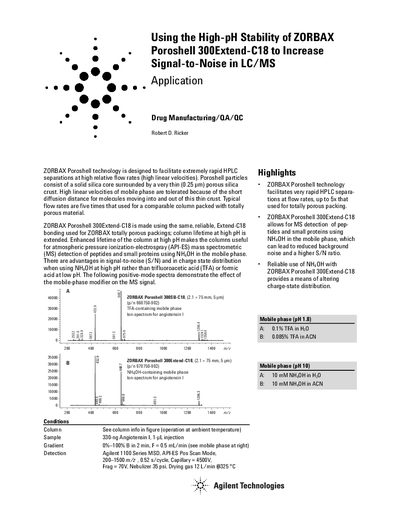
This document describes the use of ZORBAX Poroshell 300Extend-C18 columns for liquid chromatography-mass spectrometry (LC/MS) applications, specifically focusing on the analysis of peptides and small proteins. The technology utilizes a solid silica core with a thin porous silica crust to facilitate rapid HPLC separations at high relative flow rates.
The primary application highlighted is the detection of peptides using atmospheric pressure ionization-electrospray (API-ES) mass spectrometry with ammonium hydroxide (NH4OH) in the mobile phase. This approach offers advantages over traditional low-pH methods using trifluoroacetic acid (TFA) or formic acid, including reduced background noise, improved signal-to-noise (S/N) ratios, and altered charge state distributions.
| Column dimensions | 2.1 x 75 mm |
|---|---|
| Particle type | Poroshell particles |
| Flow rate capability | up to 5x that used for totally porous packing |
| Sample amount | 330-ng Angiotensin I |
| Injection volume | 1-yL |
| Flow rate | 0.5 mL/min |
| Capillary voltage | 4500V |
| Frag voltage | 70V |
| Nebulizer pressure | 35 psi |
| Drying gas flow | 12 L/min @325 °C |
Using NH4OH can lead to reduced background noise and a higher signal-to-noise (S/N) ratio compared to TFA or formic acid.
The dominant ion shifts from +2 in TFA conditions to +3 in NH4OH conditions.
The molecular ion appears at an m/z of 1296.