
Key facts
- Brand
- STMicroelectronics
- Model
- TS4962M
- Category
- Audio Power Amplifier
- Documents
- 2
- Languages
- EN
- Last added
- 2012-08-08
Start here
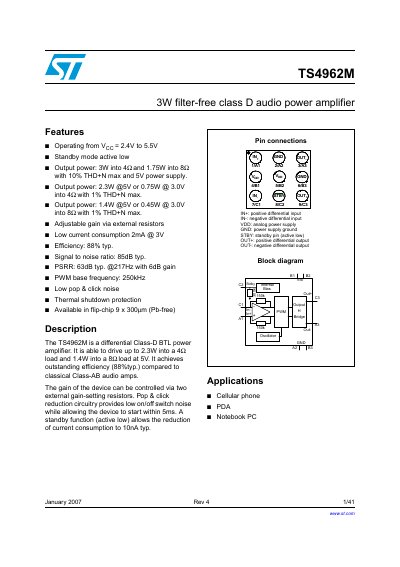
STMicroelectronics TS4962M Class D Audio Power Amplifier Datasheet
The TS4962M is a differential Class-D BTL (Bridge-Tied Load) power amplifier designed to drive up to 2.3W into a 4Ω load or 1.4W into an 8Ω load at a 5V supply voltage. It operates from a supply voltage range of 2.4V to 5.5V and achieves high efficiency, typically around 88%. The device includes features such as adjustable gain via external resistors, low pop & click noise circuitry for fast startup within 5ms, and an active-low standby function that reduces current consumption to approximately 10nA.
Read onlineSTMicroelectronics TS4962M specifications
| Supply voltage range | 2.4V to 5.5V |
|---|---|
| Output power (4Ω, 10% THD+N) | 3W |
| Output power (8Ω, 10% THD+N) | 1.75W |
| Typical efficiency | 88% |
| Signal to noise ratio (A-weighted) | 60dB (4Ω) / 57dB (8Ω) |
| PWM base frequency | 250kHz |
Source: STMicroelectronics TS4962M Class D Audio Power Amplifier Datasheet
All STMicroelectronics TS4962M documents by type
Ratings, dimensions and ordering codes, for selection and design work.
How to use the product for one specific task, with worked examples.
Questions answered in these manuals
What is the typical standby current consumption?
The device reduces current consumption to approximately 10nA in standby mode when the standby pin is active low.
From: STMicroelectronics TS4962M Class D Audio Power Amplifier Datasheet
How does the gain of the TS4962M get controlled?
The gain is adjustable via two external resistors, calculated using the formula Gain = 300kΩ/Rin.
From: STMicroelectronics TS4962M Class D Audio Power Amplifier Datasheet
What is the operating voltage range for the TS4962M?
The device operates with a supply voltage (Vcc) ranging from 2.4 V to 5.5 V.
How can the differential gain be adjusted on the demonstration board?
The differential gain can be adapted by modifying the values of resistors R1 and R2.