
Key facts
- Brand
- STMicroelectronics
- Model
- TS4909
- Category
- Other Electronics
- Documents
- 2
- Languages
- EN
- Last added
- 2012-08-08
Start here
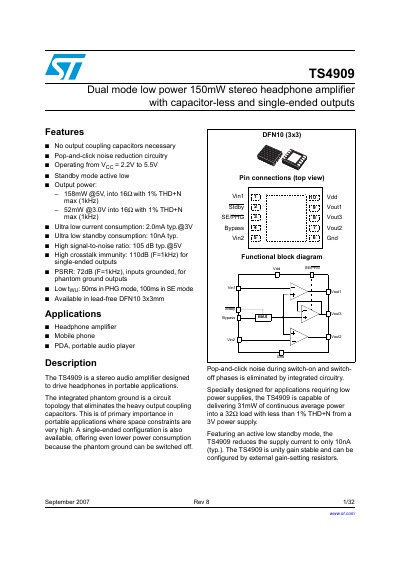
STMicroelectronics TS4909 Stereo Headphone Amplifier Datasheet
The TS4909 is a stereo audio amplifier designed to drive headphones in portable applications such as mobile phones and PDAs. It features an integrated phantom ground circuit topology that eliminates the need for heavy output coupling capacitors, which is critical for space-constrained portable devices. The device also supports a single-ended configuration to offer even lower power consumption by switching off the phantom ground.
Read onlineSTMicroelectronics TS4909 specifications
| Output power (5V, 16Ω) | 158mW |
|---|---|
| Output power (3V, 16Ω) | 52mW |
| Supply current (typical @3V) | 2.0mA |
| Standby current (typical) | 10nA |
| Signal-to-noise ratio (typical @5V) | 105 dB |
| Crosstalk immunity (single-ended) | 110dB |
| Package | DFN10 3x3mm |
Source: STMicroelectronics TS4909 Stereo Headphone Amplifier Datasheet
All STMicroelectronics TS4909 documents by type
Ratings, dimensions and ordering codes, for selection and design work.
How to use the product for one specific task, with worked examples.
Questions answered in these manuals
Does the TS4909 require output coupling capacitors?
No, the device has an integrated phantom ground circuit that eliminates the need for heavy output coupling capacitors.
From: STMicroelectronics TS4909 Stereo Headphone Amplifier Datasheet
What is the operating voltage range?
The TS4909 operates from a supply voltage of 2.2V to 5.5V.
From: STMicroelectronics TS4909 Stereo Headphone Amplifier Datasheet
What is the purpose of the DEMOTS4909 evaluation board?
The board is designed to evaluate the TS4909 low power stereo headphone amplifier with capacitor-less output.
From: STMicroelectronics AN2622 TS4909 Evaluation Board User Guidelines
How is the gain of the evaluation board set?
The gain is set at 1 V/V for both channels and can be adapted by modifying the values of resistors R1, R2, R3, or R4.
From: STMicroelectronics AN2622 TS4909 Evaluation Board User Guidelines