
Key facts
- Brand
- Philips
- Model
- BUK101-50GL
- Industry
- Industrial
- Documents
- 2
- Languages
- ZH · EN
- Last added
- 2012-07-06
Start here
Philips BUK101-50GL PowerMOS Transistor Datasheet
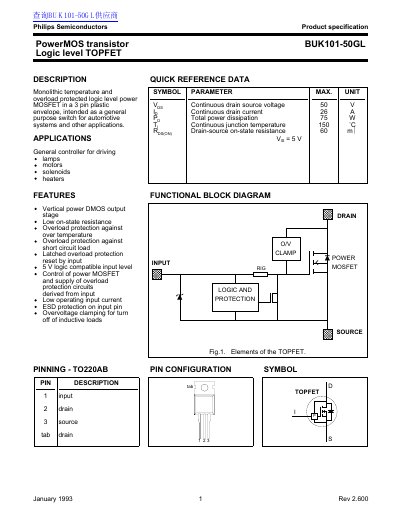
The document is a product specification sheet for the Philips Semiconductors PowerMOS transistor model BUK101-50GL. This device is described as a monolithic temperature and overload protected logic level power MOSFET in a 3-pin plastic envelope, intended for use as a general purpose switch in automotive systems and other applications.
Key features include vertical power DMOS output stage technology with low on-state resistance, overload protection against over-temperature and short circuit loads, latched overload protection reset by a 5V logic compatible input, and overvoltage clamping for turnoff of inductive loads. The datasheet details limiting values, thermal characteristics, static and switching parameters, and provides typical characteristic curves. This manual is written in Chinese.
Philips BUK101-50GL specifications
| Continuous drain source voltage (VDS) | 50 V |
|---|---|
| Continuous drain current (ID) at Tmb ≤ 25 °C | 26 A |
| Total power dissipation (PD) | 75 W |
| Continuous junction temperature (Tj) | 150 °C |
| Drain-source on-state resistance (RDS(ON)) | 60 m Ω |
All Philips BUK101-50GL documents by type
Ratings, dimensions and ordering codes, for selection and design work.
Questions answered in these manuals
How does the device protect against over-temperature?
The device features overload protection against over temperature, which operates at a threshold junction temperature of 150 °C.
What is the maximum continuous drain current at a case temperature of 25 °C?
The maximum continuous drain current is 26 A when the case temperature is 25 °C.
What are the main applications for this device?
It is intended as a general purpose switch for automotive systems and other applications, specifically for driving lamps, motors, solenoids, and heaters.
What is the maximum clamping energy for non-repetitive events?
The maximum non-repetitive clamping energy (Epsm) is 625 mJ under specific conditions.