
Key facts
- Brand
- Agilent
- Model
- DMS 90
- Documents
- 2
- Languages
- EN
- Last added
- 2012-06-11
Start here
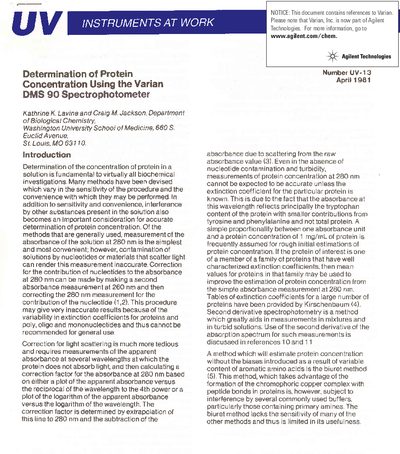
Varian DMS 90 Spectrophotometer Protein Determination Guide
This document describes various laboratory procedures for determining protein concentration in solutions. It discusses the principles of measuring absorbance at 280 nm and compares this with other methods such as the biuret reaction, the Lowry assay, and the Coomassie Brilliant Blue G-250 dye-binding procedure.
Read onlineAgilent DMS 90 specifications
| Spectral Bandwidth (280 nm) | 1.0 nm |
|---|---|
| Wavelength for Biuret Assay | 540 nm |
| Sensitivity (280 nm for Albumin) | 0.64 absorbance units per mg/mL |
| Sensitivity (Lowry Assay) | 1.67 absorbance units per mg/mL |
| Wavelength for Coomassie Assay | 595 nm |
Source: Varian DMS 90 Spectrophotometer Protein Determination Guide
All Agilent DMS 90 documents by type
Day-to-day operation, settings and troubleshooting. Start here if the product is already set up.
How to use the product for one specific task, with worked examples.
Questions answered in these manuals
What is the sensitivity of the 280 nm assay for bovine plasma albumin?
The sensitivity is 0.64 absorbance units per mg/mL.
From: Varian DMS 90 Spectrophotometer Protein Determination Guide
How much more sensitive is the Lowry assay compared to 280 nm measurement?
It is approximately three times more sensitive.
From: Varian DMS 90 Spectrophotometer Protein Determination Guide
What wavelength is used to measure hexavalent chromium?
The absorbance of the developed color is measured at 540 nm.
From: Agilent DMS 90 UV-Visible Spectrophotometer Hexavalent Chromium Determination Application Note
What slit width was used for this experiment?
A slit width of 2 nm was used because the chromium peak is broad.
From: Agilent DMS 90 UV-Visible Spectrophotometer Hexavalent Chromium Determination Application Note