
Key facts
- Brand
- Philips
- Model
- HCT374
- Industry
- Industrial
- Documents
- 3
- Languages
- EN
- Last added
- 2012-07-02
Start here
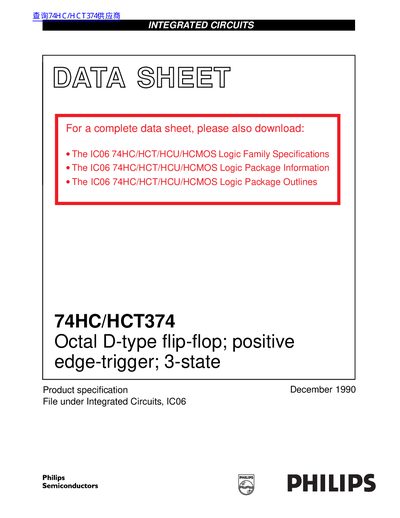
PHILIPS 74HC/HCT374 Octal D-type flip-flop; positive edge-trigger; 3-state handbook
The Philips 74HC/HCT374 is a high-speed Si-gate CMOS device featuring an 8-bit positive, edge-triggered register with common 3-state output enable input. These devices are pin compatible with low power Schottky TTL (LSTTL) and are specified in compliance with JEDEC standard no. 7A. They are designed for bus-oriented applications where the outputs can be placed in a high impedance OFF-state.
Read onlinePhilips HCT374 specifications
| Logic Category | MSI |
|---|---|
| Maximum Clock Frequency | 77 MHz |
| Input Capacitance | 3.5 pF |
| Supply Voltage (Vcc) | GND to Vcc |
Source: PHILIPS 74HC/HCT374 Octal D-type flip-flop; positive edge-trigger; 3-state handbook
All Philips HCT374 documents by type
Ratings, dimensions and ordering codes, for selection and design work.
Questions answered in these manuals
What is the function of the OE input?
When OE is LOW, the contents of the flip-flops are available at the outputs; when OE is HIGH, the outputs go to the high impedance OFF-state.
From: PHILIPS 74HC/HCT374 Octal D-type flip-flop; positive edge-trigger; 3-state handbook
Are the outputs inverting or non-inverting?
The device features 3-state non-inverting outputs.
From: PHILIPS 74HC/HCT374 Octal D-type flip-flop; positive edge-trigger; 3-state handbook
What is the function of the OE input?
When OE is LOW, the contents of the flip-flops are available at the outputs. When OE is HIGH, the outputs go to the high impedance OFF-state.
From: PHILIPS 74HC/HCT374 Octal D-type flip-flop; positive edge-trigger; 3-state Data Sheet
Is the 74HC/HCT374 functionally identical to the 534?
Yes, the 374 is functionally identical to the 534, but it has non-inverting outputs.
From: PHILIPS 74HC/HCT374 Octal D-type flip-flop; positive edge-trigger; 3-state Data Sheet
What happens to the outputs when the OE pin is HIGH?
The outputs go to the high‑impedance OFF‑state.
Which pins provide the data inputs for the flip‑flops?
Pins 3, 4, 7, 8, 13, 14, 17, and 18 are the D inputs.