
Key facts
- Brand
- Philips
- Model
- HCT74
- Industry
- Industrial
- Documents
- 2
- Languages
- EN
- Last added
- 2012-07-02
Start here
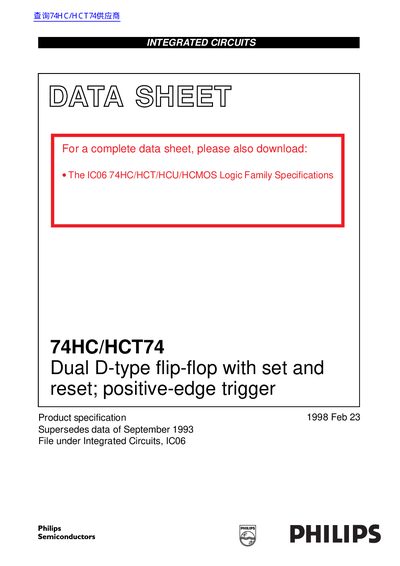
Philips 74HC/HCT74 Dual D-type Flip-Flop Datasheet
The Philips 74HC/HCT74 is a high-speed Si-gate CMOS device that is pin compatible with low power Schottky TTL (LSTTL). It features dual positive-edge triggered D-type flip-flops with individual data inputs, clock inputs, and asynchronous set and reset inputs. The device operates with complementary Q and Q outputs and is specified in compliance with JEDEC standard no. 7A.
Read onlinePhilips HCT74 specifications
| Output capability | standard |
|---|---|
| Loc category | flip-flops |
| Maximum clock frequency (74HC) | 76 MHz |
| Input capacitance | 3.5 pF |
All Philips HCT74 documents by type
Ratings, dimensions and ordering codes, for selection and design work.
Questions answered in these manuals
What type of trigger does the 74HC/HCT74 use?
The device uses positive-edge triggering for data transfer to the output.
Are the set and reset inputs synchronous or asynchronous?
The set and reset inputs are asynchronous and active LOW.
What is the maximum clock frequency for the 74HC/HCT74?
The HC version can operate up to 76 MHz, while the HCT version is limited to 59 MHz.
What is the recommended maximum temperature for wave or reflow soldering?
The soldering temperature should not exceed 260 °C, and contact time must be limited to a few seconds.