
Key facts
- Brand
- Philips
- Model
- HCT221
- Industry
- Industrial
- Documents
- 3
- Languages
- EN
- Last added
- 2012-07-02
Start here
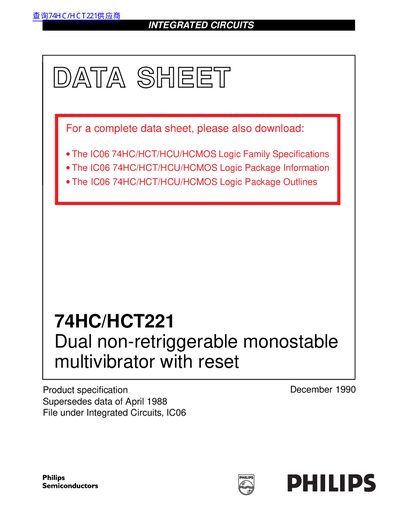
Philips 74HC/HCT221 Dual Monostable Multivibrator Datasheet
The Philips 74HC/HCT221 is a high-speed Si-gate CMOS device featuring dual non-retriggerable monostable multivibrators. It is pin compatible with low power Schottky TTL (LSTTL) and specified in compliance with JEDEC standard no. 7A. Each multivibrator includes active LOW-going and active HIGH-going edge inputs, allowing for flexible pulse triggering.
Read onlinePhilips HCT221 specifications
| Pulse width variance | typically less than + 5% |
|---|---|
| Icc category | MSI |
| Output pulse width | 630 to 805 us |
Source: Philips 74HC/HCT221 Dual Monostable Multivibrator Datasheet
All Philips HCT221 documents by type
Ratings, dimensions and ordering codes, for selection and design work.
Questions answered in these manuals
What is the function of the nRp inputs?
The nRp inputs are direct reset inputs that are active LOW and can terminate the output pulse.
From: Philips 74HC/HCT221 Dual Monostable Multivibrator Datasheet
How is the output pulse width defined?
The output pulse width is defined by the relationship tw = 0.7CextRext.
From: Philips 74HC/HCT221 Dual Monostable Multivibrator Datasheet
What pins are the trigger inputs on the 74HC/HCT221?
Pins 1 and 9 are the negative‑edge trigger inputs (nA), while pins 2 and 10 are the positive‑edge trigger inputs (nB).
From: Philips 74HC/HCT221 Dual Non-retriggerable Monostable Multivibrator Datasheet
How is the output pulse width calculated?
The output pulse width is defined by tw = 0.7 × Cext × Rext.
From: Philips 74HC/HCT221 Dual Non-retriggerable Monostable Multivibrator Datasheet