
Key facts
- Brand
- Agilent
- Model
- 385-ELSD
- Documents
- 5
- Languages
- EN
- Last added
- 2012-07-04
Start here
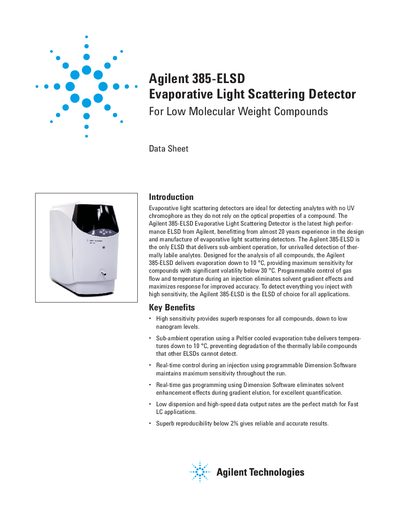
Agilent 385-ELSD Evaporative Light Scattering Detector Data Sheet
The Agilent 385-ELSD is an Evaporative Light Scattering Detector designed for analyzing low molecular weight compounds that lack UV chromophores. It features unique sub-ambient operation, utilizing a Peltier cooled evaporation tube to reach temperatures down to 10 °C, which prevents the degradation of thermally labile analytes.
The instrument provides high sensitivity with responses down to low nanogram levels and offers superb reproducibility below 2%. Key capabilities include real-time control of gas flow and temperature during injections via Dimension Software, eliminating solvent gradient effects. It is fully integrated with Agilent analytical LC systems and compatible with multi-vendor software.
Agilent 385-ELSD specifications
| Minimum Evaporation Temperature | 10 °C |
|---|---|
| Reproducibility | below 2% |
| Detection Limit | low nanogram levels |
Source: Agilent 385-ELSD Evaporative Light Scattering Detector Data Sheet
All Agilent 385-ELSD documents by type
Ratings, dimensions and ordering codes, for selection and design work.
How to use the product for one specific task, with worked examples.
- Agilent 385-ELSD Enhanced Analysis of Semi-volatile Compounds Application Note 3 p
- Agilent 385-ELSD Evaporative Light Scattering Detector Application Note for Polar Lipid Analysis 4 p
- Agilent 385-ELSD Evaporative Light Scattering Detector Application Note 4 p
- Agilent 500 Ion Trap MS and 385-ELSD Application Note for Pharmaceutical Analysis 8 p
Questions answered in these manuals
What is the minimum temperature the Agilent 385-ELSD can operate at?
The detector delivers sub-ambient operation with evaporation temperatures down to 10 °C.
From: Agilent 385-ELSD Evaporative Light Scattering Detector Data Sheet
Does the Agilent 385-ELSD require an analog-to-digital converter?
No, it does not require one because it supports multi-vendor software control and data acquisition.
From: Agilent 385-ELSD Evaporative Light Scattering Detector Data Sheet
What is the lowest operating temperature for sub-ambient ELSD detection with this instrument?
The 385-ELSD contains a Peltier cooled evaporation tube that provides sub-ambient ELS detection down to 10 °C.
From: Agilent 385-ELSD Enhanced Analysis of Semi-volatile Compounds Application Note
How much does the sensitivity for PEG 106 improve when the temperature is reduced from 30 °C to 20 °C?
PEG 106 shows a 40-fold increase in sensitivity when the temperature is reduced from 30 °C to 20 °C.
From: Agilent 385-ELSD Enhanced Analysis of Semi-volatile Compounds Application Note
What is the Agilent 385-ELSD used for?
It is used for the sensitive analysis of polar lipids via HPLC, such as cholesterol and phosphatidylcholine.
From: Agilent 385-ELSD Evaporative Light Scattering Detector Application Note for Polar Lipid Analysis
What are the standard operating temperatures for the detector?
The nebulizer temperature is set to 40°C and the evaporation temperature is set to 90°C.
From: Agilent 385-ELSD Evaporative Light Scattering Detector Application Note for Polar Lipid Analysis