
This Application Note demonstrates that the combination of HPLC with the Agilent 385-ELSD Evaporative Light Scattering Detector provides a better alternative for the sensitive analysis of polar lipids. Evaporative light scattering detection is universal and not dependent on the optical properties of the compound, making it ideal for analysis of lipids such as cholesterol and phosphatidylcholine that have very poor UV chromophores. ELS detection recognizes any compound that is less volatile than the mobile phase. This makes ELS detection fully compatible with HPLC elution gradients. ELS detection also eliminates the need for pre-analysis derivatization to enhance UV absorbance, facilitating rapid determination of lipids in complex matrices.
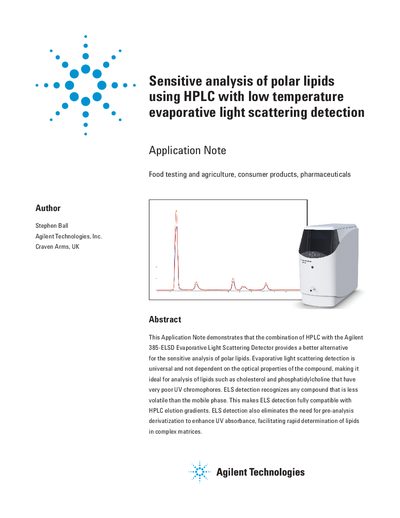
This document is an application note demonstrating that the combination of High Performance Liquid Chromatography (HPLC) with the Agilent 385-ELSD Evaporative Light Scattering Detector provides a superior alternative for the sensitive analysis of polar lipids. The text explains that ELS detection is universal and not dependent on optical properties, making it ideal for compounds like cholesterol and phosphatidylcholine which have poor UV chromophores.
It is used for the sensitive analysis of polar lipids via HPLC, such as cholesterol and phosphatidylcholine.
The nebulizer temperature is set to 40°C and the evaporation temperature is set to 90°C.
The procedure requires an injection volume of 10 pL.