
The Agilent 385-ELSD Evaporative Light Scattering Detector is the latest high-performance ELSD from Agilent, benefitting from almost 20 years experience in the design and manufacture of evaporative light scattering detectors. It is ideal for detecting analytes with no UV chromophore as they do not rely on the optical properties of a compound. Designed for the analysis of all compounds, it delivers evaporation down to 10 °C, providing maximum sensitivity for compounds with significant volatility below 30 °C. Programmable control of gas flow and temperature during an injection eliminates solvent gradient effects and maximizes response for improved accuracy.
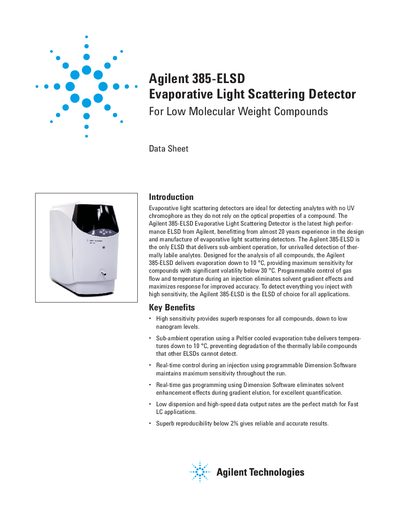
The Agilent 385-ELSD is an Evaporative Light Scattering Detector designed for analyzing low molecular weight compounds that lack UV chromophores. It features unique sub-ambient operation, utilizing a Peltier cooled evaporation tube to reach temperatures down to 10 °C, which prevents the degradation of thermally labile analytes.
The instrument provides high sensitivity with responses down to low nanogram levels and offers superb reproducibility below 2%. Key capabilities include real-time control of gas flow and temperature during injections via Dimension Software, eliminating solvent gradient effects. It is fully integrated with Agilent analytical LC systems and compatible with multi-vendor software.
| Minimum Evaporation Temperature | 10 °C |
|---|---|
| Reproducibility | below 2% |
| Detection Limit | low nanogram levels |
The detector delivers sub-ambient operation with evaporation temperatures down to 10 °C.
No, it does not require one because it supports multi-vendor software control and data acquisition.
The instrument offers superb reproducibility below 2% for improved consistency of results.