
Application Note: Sensitive analysis of parabens using HPLC with evaporative light scattering detection at subambient temperatures
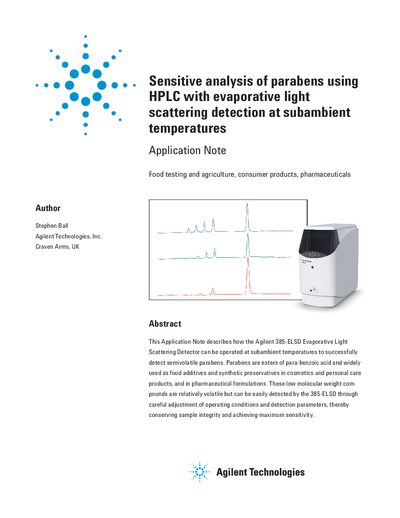
This document is an application note detailing the use of the Agilent 385-ELSD Evaporative Light Scattering Detector for the sensitive analysis of parabens. It explains how operating the detector at subambient temperatures, such as 20°C, improves the recovery of low molecular weight compounds like methyl paraben compared to standard temperatures like 30°C.
The note provides specific experimental conditions for the analysis, including the use of a Pursuit C18 column, a flow rate of 0.2 mL/min, and a specific gradient of acetonitrile in water. It concludes that the 385-ELSD offers superior performance for semivolatile compounds due to its innovative gas control design.
| Nebulizer temp | 30 °C |
|---|---|
| Gas flow | 1.4SLM |
| Flow rate | 0.2 mL/min |
| Column | Pursuit C18, 150 x 2.1 mm |
Subambient temperatures of 20 °C achieve further improvements in the recovery of methyl paraben.
The flow rate used in the experiment is 0.2 mL/min.