
Key facts
- Brand
- STMicroelectronics
- Model
- ST485EB
- Category
- Other Electronics
- Documents
- 3
- Languages
- EN
- Last added
- 2012-08-08
Start here
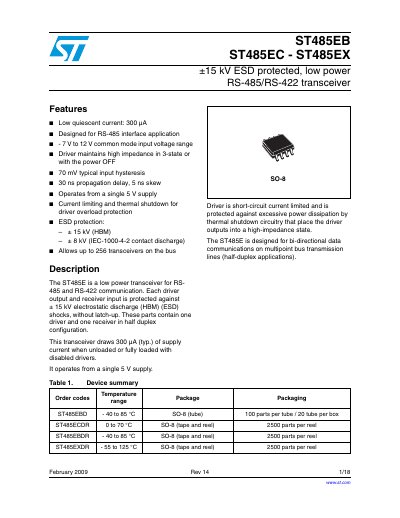
ST ST485EB ST485EC ST485EX handbook
The ST485EB, ST485EC, and ST485EX are low power transceivers designed for RS-485 and RS-422 communication applications. Each device contains one driver and one receiver in a half-duplex configuration, allowing up to 256 transceivers on the bus.
Read onlineSTMicroelectronics ST485EB specifications
| Supply voltage | 5 V |
|---|---|
| Quiescent current (typical) | 300 µA |
| ESD protection (HBM) | +15 kV |
| Common mode input voltage range | -7 V to 12 V |
| Maximum data rate | 5 Mbps |
All STMicroelectronics ST485EB documents by type
Ratings, dimensions and ordering codes, for selection and design work.
How to use the product for one specific task, with worked examples.
Questions answered in these manuals
What is the typical quiescent current?
The device draws 300 µA of supply current when unloaded or fully loaded with disabled drivers.
How many transceivers can be on the bus?
The design allows up to 256 transceivers to operate on the same bus.
What is the maximum recommended signaling rate for e-meter applications?
Most e-meter applications require signaling rates below 250 kbit/s.
From: ST AN1702 handbook
What is the maximum cable length supported by the ST485EB at 250 kbit/s?
The ST485EB supports cable lengths up to 1 km at signaling rates below 250 kbit/s.
From: ST AN1702 handbook
What is the purpose of fail-safe biasing?
Fail-safe biasing solves the problem where all drivers are disabled, providing the bus with a proper known state instead of an undefined one.
From: STMicroelectronics AN1690 Application Note Fail-Safe Biasing for ST485EB
What is the minimum voltage drop required for fail-safe bias?
The external resistors must provide at least a 200 mV bias across the line.
From: STMicroelectronics AN1690 Application Note Fail-Safe Biasing for ST485EB